Ask five marketers what AEO and GEO mean and you will get five different answers. Business owners want just one answer: how do we show up when a customer asks an AI tool for a recommendation?
Google has now given its clearest response yet. Below, we explain what changed, what it means for AEO and GEO, and what a business in India can do this month without wasting budget on hype.
What Are AEO and GEO in Plain Words?
Answer engine optimization (AEO) means shaping your content so search features and AI assistants can lift a clear, direct answer from it. Generative engine optimization (GEO) goes one step further. It focuses on getting your brand cited or mentioned inside AI-written responses from Google AI Overviews, ChatGPT, Gemini and Perplexity.
Both terms sit next to traditional SEO. As you will see, the overlap is much bigger than many agencies admit.
What Google Actually Said About AEO and GEO
Google’s guide to optimizing for generative AI features on Google Search is direct. Its answer is that AEO and GEO are still SEO. Search Engine Journal covered the guide when it appeared in May 2026, noting that it pulls together advice that was earlier scattered across conference talks and interviews.
What Google Says You Can Skip
The guide names several popular tactics that Google Search does not need:
- llms.txt files and other special AI files or markup
- Splitting pages into tiny “chunks” written for machines
- Rewriting content to capture every long-tail keyword variation
- Chasing artificial brand mentions
- Adding special schema just for AI features
Structured data is still useful for rich results. It is simply not a magic switch for AI answers. One caution: this is Google’s view of Google Search. ChatGPT and Perplexity may weigh signals differently, so we treat the guide as a strong baseline, not the full picture.
What Google Wants Instead
Google puts weight on non-commodity content, meaning pages that add insight beyond what everyone already says. A generic “seven tips” post is commodity content. A page that shares what actually happened on a real project is not.
Beyond that, the basics apply. Pages must be indexed and eligible for snippets, load well, avoid duplication and use clean HTML. For shops and local businesses, Google also points to Merchant Center feeds and Google Business Profiles.
Why This Matters Right Now
AI search is no longer a side project. Comscore data, as summarised in a recent industry recap, shows AI Overviews on 39.4% of US desktop searches. An Ahrefs study of 300,000 keywords found that the top-ranking page had a 58% lower click-through rate when an AI Overview appeared.
Volatility is real too. Google released its September 2026 spam update on September 24, and it may take up to two weeks to finish. If your traffic moves this month, check the timing before you rewrite anything. Google has also begun rolling out Generative AI reports in Search Console for some sites, so measurement is slowly improving.
The lesson is simple. Rankings still matter, but visibility now also means being cited, mentioned and remembered.
How to Optimize for AI Search Without Chasing Hacks
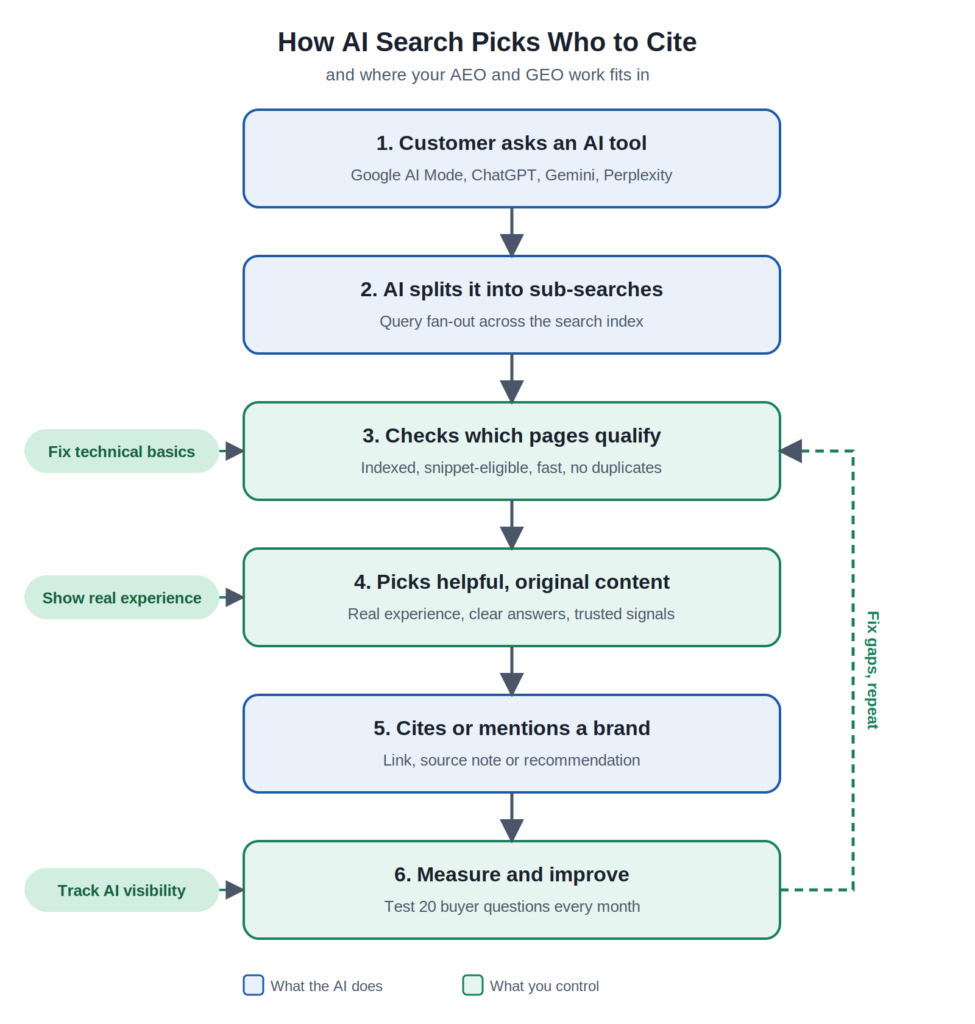
1. Answer the Question Early
Lead each section with a direct answer in two or three sentences, then explain. Readers and AI systems both find that easier to use. This is about user intent, not a trick. Add a short FAQ where customers genuinely ask questions.
2. Show Real Experience
E-E-A-T is what separates useful pages from filler. Use named authors, first-hand examples, original numbers and honest limits. Our earlier post on whether Google AI Mode will take over search explains why original insight is something AI can only get from you.
3. Fix the Technical Basics
Check that important pages are crawlable, indexable and snippet-eligible. Use semantic headings, keep pages fast and remove near-duplicate pages. FAQ or product schema is still worth adding for rich results, just do not expect it to guarantee AI citations.
4. Strengthen Local and Product Signals
Keep your Google Business Profile complete and current, and keep product feeds accurate. When a customer asks an AI tool for the best option nearby, these signals help feed the answer.
5. Build Presence Beyond Your Website
Reviews, YouTube videos, industry mentions and community discussions all shape how AI describes a brand. Do not fake them. Google itself says artificial mentions are less helpful than they seem. Citation patterns also swing fast. One September analysis reported Reddit’s share of ChatGPT Search citations falling 86.4% in four days, so diversify.
6. Measure What AI Says About You
Each month, test 20 real customer questions in Google AI Mode, ChatGPT, Gemini and Perplexity. Note whether you are mentioned and whether the answer is accurate. Bing’s reporting helps too, and we covered it in our guide to the Bing AI Performance report. Our future-proof SEO strategy for 2026 also shows how intent-based content clusters support this work.
Do Not Bet on a Single AI Assistant
One recap of Comscore data suggests ChatGPT’s share of assistant prompts has fallen to roughly half this year as Gemini and others grow. A plan that checks only one assistant misses the rest, so track Google, ChatGPT, Gemini and Perplexity together.
Frequently Asked Questions
What is the difference between AEO and GEO?
AEO aims to make your content the direct answer in search features and assistants. GEO aims to get your brand cited or recommended inside AI-generated responses. In practice, both depend on clear, trustworthy content, so most of the work overlaps.
Do I need an llms.txt file?
Google says it is not needed for Google Search or its AI features. Fix your content and technical basics before spending time or budget there.
Is SEO still relevant with AI Overviews?
Yes. Google’s AI features are built on its core ranking and quality systems, so indexable, useful and trustworthy pages remain the starting point.
How long does it take to appear in AI answers?
Nobody can promise a fixed timeline. Some pages get cited within weeks and others never do. Focus on quality, and measure every month.
Can small businesses compete in AI search?
Yes. Local knowledge, real customer stories and accurate business profiles are hard for large brands to copy.
Where to Start This Month
Pick your ten most important pages. Make sure each one answers a real customer question clearly, shows real experience and loads cleanly. Then test them in AI tools and fix whatever gets misread. That work beats any special file or plugin.
If you want a team to run this with you, the SEO services from Medowa Global are built around search that works for people and AI systems alike.