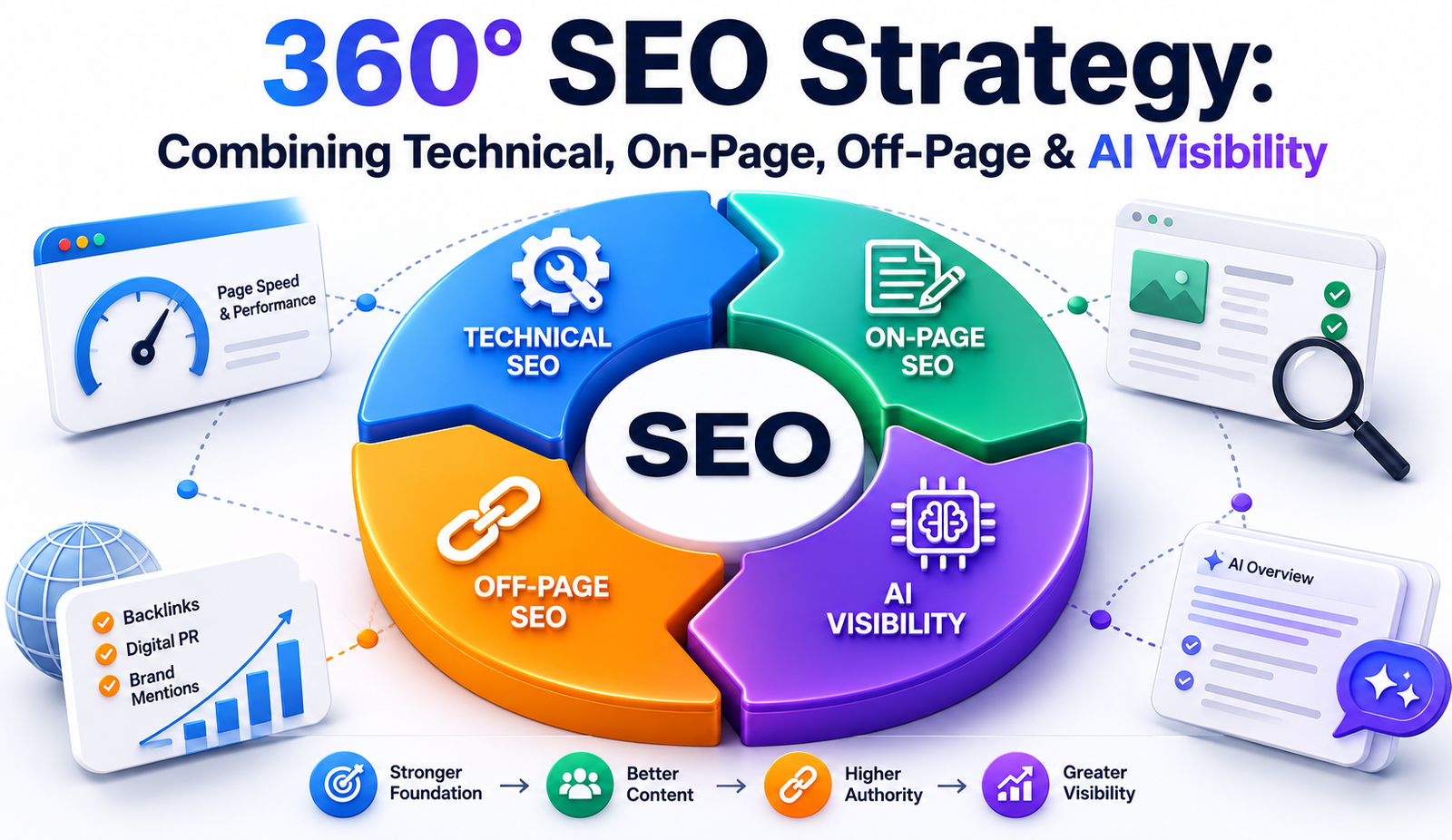
Search engine optimization used to be simpler. Write good content, get a few backlinks, done. That world doesn’t exist anymore. A website can have flawless on-page content and still fail to rank if its technical foundation is shaky, or it can have solid backlinks and still lose visibility if AI-driven search summaries never surface at all. At Medowa, working across multiple client accounts has made one thing clear: the brands actually gaining ground right now treat SEO as one connected system, not four separate checklists handled by four different people.
Why a Siloed SEO Approach No Longer Works
Plenty of businesses still split technical SEO, content, link building, and AI optimization across different teams that barely talk to each other. The result is usually inconsistency a beautifully written blog sitting on a page that takes six seconds to load, or a technically flawless site filled with thin, generic content nobody asked for. Search engines and AI models both reward coherence across these layers. Excelling at just one rarely moves the needle the way people hope.
Technical SEO The Foundation Nobody Sees
None of the rest matters much if search engines can’t crawl, render, and actually understand your site.
Core Web Vitals
Page speed, interactivity, and visual stability affect rankings, sure, but they affect user behavior even more directly. A visitor who bounces before the page finishes loading never gets to judge your content and that bounce itself becomes a quality signal search engines pick up on.
Crawlability & Indexation
A clean XML sitemap, a logical URL structure, and a properly configured robots.txt file all help search engines spend their crawl budget where it counts. Orphan pages and broken internal links quietly drain that budget without anyone noticing until rankings start slipping.
Schema Markup
Structured data gives search engines context product details, FAQs, reviews, organizational info which improves the odds of rich results and, increasingly, of showing up correctly when AI tools summarize search results.
On-Page SEO Content Built Around Search Intent
Once the technical base holds up, content has to actually answer what people are searching for, and do it in a way that reflects real understanding, not a rehash of the top five results.
E-E-A-T Signals
Google’s push on Experience, Expertise, Authoritativeness, and Trustworthiness means content should read like it comes from someone who’s actually done the thing, not someone who read about it. Author context, accurate data, and transparent sourcing all build that trust, with readers and algorithms alike.
Keyword Optimization Without Stuffing
Good on-page SEO today isn’t about repeating a keyword until the sentence sounds broken. It’s about covering a topic thoroughly enough that related terms and semantic search variations show up naturally, the way they would in an expert’s actual explanation. Google’s own guidance is blunt about this: content should be created for people first, not to game rankings and that remains the clearest predictor of what holds up long-term in the SERPs.
Off-Page SEO Authority Built Beyond Your Own Site
A website’s own pages can only say so much about how credible it is. The rest of the internet has to vouch for it too.
Backlinks & Digital PR
Links from relevant, authoritative sources tell search engines that other credible voices trust what you’re saying. Quality beats quantity here every time a handful of contextually relevant backlinks will outperform dozens of low-value ones aimed purely at boosting organic traffic numbers.
Content Syndication
Spreading content across platforms like Medium, Scoop.it, and industry directories each one adapted to that platform’s tone and format rather than copy-pasted extends topical authority without tripping duplicate content flags. This is a core part of how we handle off-page visibility for clients at Medowa, and it’s one of the more underrated levers in a broader content marketing plan.
AI Visibility Optimizing for AI Search & Answer Engines
With AI Overviews, chat-based search, and answer engines becoming default discovery points for a lot of users, ranking on a traditional results page isn’t the finish line anymore.
Structured, Extractable Content
AI systems favor content that’s easy to parse clear headings, direct answers early in a section, well-organized lists. Content buried in dense, unbroken paragraphs is just harder for these systems to extract and cite, no matter how good the information actually is.
Brand Mentions Across the Web
AI-generated answers often pull from multiple sources at once rather than linking to a single page. Consistent, accurate brand mentions across reputable third-party platforms raise the odds of being referenced in an AI-generated answer, even in zero-click search scenarios where the user never visits the site directly. This is where generative engine optimization (GEO) starts to overlap heavily with traditional off-page work.
Bringing It All Together: A 360° Framework
Businesses gaining ground right now aren’t necessarily doing anything radically new they’re just doing technical, on-page, off-page, and AI optimization in sync instead of in sequence. A fast, well-structured site with strong UX signals feeds better content performance. Strong content earns better backlinks. Backlinks and mentions strengthen AI visibility. And AI visibility increasingly feeds back into direct brand searches. Treating these as one continuous loop rather than four separate checkboxes is what separates SEO that plateaus from SEO that compounds over time.
FAQ
Q: Which should a business prioritize first technical, on-page, or off-page SEO? Technical SEO usually comes first, since crawlability and page speed issues can undercut even the strongest content. Once that’s stable, on-page and off-page work can run in parallel.
Q: How does AI search visibility differ from traditional SEO? Traditional SEO optimizes for ranking on a results page. AI visibility optimizes for being accurately extracted, summarized, and cited within AI-generated answers which leans heavily on structured content and consistent brand mentions elsewhere online.
Q: Can a small business realistically manage all four SEO pillars at once? Yes, with a phased approach. Fixing critical technical issues, publishing consistent E-E-A-T-driven content, and building a handful of quality backlinks each month is far more sustainable than trying to do everything at once.
Final Thought
SEO in 2026 isn’t won by chasing every algorithm update as it drops it’s won by building a site that’s fast, credible, well-linked, and easy for both humans and AI systems to understand. When technical health, content quality, off-page authority, and AI visibility move together, growth stops looking like a series of random spikes and starts looking like a steady, compounding curve. That shift is worth making now, before it becomes the baseline everyone’s expected to hit.
Staying ahead of updates like this and translating them into real business growth is exactly what we help brands do at Medowa Global, keeping your digital marketing strategy aligned with where search and AI visibility are headed.