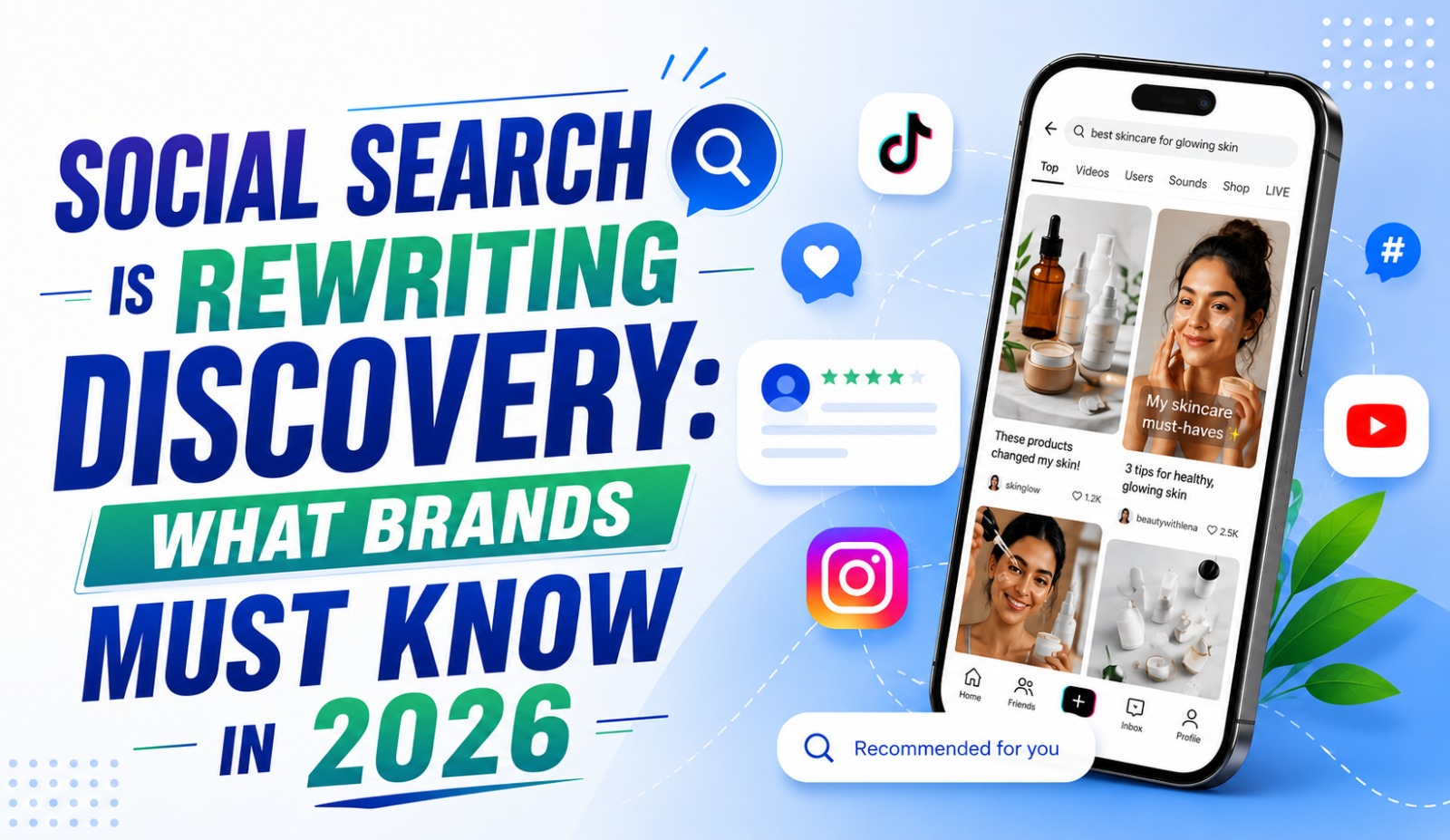
A few years ago, “search” meant one thing: open Google, type a query, click a link. That habit is breaking down. When people want to find a product, compare prices, or decide where to eat, more and more of them are reaching for TikTok, Instagram, or YouTube before they ever open a browser. And this isn’t just a Gen Z quirk we can wait out, it’s a real shift in how discovery works, and it’s already forcing marketers to rethink strategies that were built around traditional SEO and not much else.
This piece walks through what’s actually changing across social search, platform messaging, and AI-driven commerce, and what it means for any brand that wants to stay visible in 2026.
Why Social Search Is Becoming the New Discovery Engine
The numbers back this up. Several industry reports now show social platforms pulling in a bigger share of product discovery than traditional search engines, in some cases by a wide margin. Younger consumers especially are skipping Google entirely, heading straight to TikTok or Instagram for reviews, demos, and the kind of first-person honesty you just don’t get from a polished product listing.
It’s not that people have stopped searching, they’ve just redefined what searching looks like. Someone scrolling TikTok for “best skincare routine for oily skin” is doing a search, full stop, just not on a search engine in the traditional sense. The intent behind that query is no different from what they’d type into Google. What’s different is where they go to find an answer, and who they trust to give it. A traveler planning a trip to Bali might watch a dozen TikToks on hidden cafes and budget stays before ever opening a travel website, by the time they do search “Bali itinerary” on Google, they’ve already half-decided where they’re going.
What Drives Social Search Behavior
Ask people why they prefer social search over a Google query, and the same themes keep coming up: the short-form video format, the storytelling, the sense that what they’re watching is current and real rather than something written by a marketing team months ago. People don’t just want information anymore, they want to watch someone actually use the product and react honestly, then decide for themselves whether to believe it.
That changes what content strategy has to look like. Heavily branded, over-produced content tends to fall flat compared to a genuine demo, a quick tutorial, or someone simply sharing what happened when they tried something. Nobody handed down an official rule for this, but authenticity has basically become a ranking factor on its own. Beauty brands learned this early, a lot of skincare and makeup labels now lean almost entirely on creator try-on videos and unscripted reactions instead of studio shoots, because that’s what actually gets watched and shared.
Where Google Fits Into the New Landscape
To be clear, Google isn’t going anywhere. It’s still the platform most people trust when the stakes are higher, health questions, financial decisions, legal advice, the kind of thing where you want a verified, comprehensive answer rather than someone’s personal take. Social platforms tend to win on the experiential, lifestyle side of things; Google and AI-driven engines still dominate when people need something authoritative. In fact, 70% of social media users use Google Search to validate products they first discovered on social, proving the two channels work together rather than compete.”
So the real question isn’t whether to choose social search over Google. It’s about matching the right platform to the right stage of the customer’s decision: social search for discovery and inspiration, traditional search and AI overviews for the final check before someone actually buys. A strategy that leans on both ends up far more resilient than one built around a single channel.
YouTube's Return of Direct Messaging Changes the Relationship Game
YouTube has brought back direct messaging for users 18 and older, but with one notable change from before: the recipient now has to consent before a conversation can even start. That single design decision says a lot about how seriously the platform is taking spam this time around.
For brands and creators, this reopens a real opportunity to build closer, one-on-one relationships with people who already watch their content, but it shuts the door on cold outreach completely. Someone has to actively choose to receive messages, which means this channel only really works once trust already exists. In practice, that rewards the creators and businesses who’ve already put in the work building community through comments and content, not anyone hoping to use DMs as a shortcut to new customers. Think of a small fitness coach who’s spent a year answering comments on workout videos, when consent-based DMs open up, those are exactly the followers likely to opt in, because the relationship was already there before the message ever arrived.
Meta's AI Agents Are Turning Messaging Apps Into Storefronts
Probably the bigger story here, and the one getting less attention, is what’s happening quietly inside Meta’s messaging apps. Meta has rolled out AI-powered business agents that can answer customer questions, qualify leads, and book appointments, all without a human stepping in at any point.
This isn’t a minor chatbot update. It’s a deliberate move to keep the entire customer journey, from the first question to the final purchase, inside one conversation thread. And the scale tells the story: in-app purchasing has now crossed $1.09 trillion globally, which says a lot about how comfortable people have become completing a transaction without ever leaving the app where the conversation started.
Why This Matters for Customer Experience
When an AI agent can handle lead qualification and appointment booking on its own, human teams get freed up for the conversations that actually need a person. But it also raises expectations fast. Once someone gets an instant, accurate answer from one brand’s Instagram account, they’re going to expect the same from the next one. Brands still relying on someone manually checking messages are going to lose leads simply because they can’t move as fast as the automated alternative. A salon, for instance, that lets a WhatsApp agent confirm appointment slots at midnight will keep the booking that a competitor loses simply because nobody replied until the next morning.
What This Means for Your Marketing Strategy
Three things are happening at once, and they’re all connected.
First, discovery has shifted onto social platforms, so visibility now depends as much on short-form video performance and creator partnerships as it does on keyword rankings.
Second, messaging has turned from a support function into an actual sales channel. AI-driven response systems aren’t really optional anymore, they’re becoming the baseline expectation, because people now want instant, accurate answers no matter which channel they’re using.
Third, more transactions are happening inside the same app where the conversation began. That means a smooth in-app buying experience, backed by a capable AI agent, matters just as much as the content that got someone interested in the first place.
Building a Social Search Strategy That Reflects How People Actually Search Today
Instead of treating TikTok, Instagram, and YouTube as top-of-funnel channels that eventually funnel people toward a website, it makes more sense to treat them as complete discovery-to-purchase ecosystems in their own right. That means putting real effort into authentic, creator-style content for the discovery stage, keeping SEO and AI Overview optimization sharp for the validation stage, and making sure messaging apps are backed by AI agents capable of carrying a conversation all the way to a booking or a sale.
Frequently Asked Questions
Is social search replacing Google? Not really, at least not yet. Social search is winning the discovery-stage and lifestyle queries, product reviews, beauty advice, restaurant recommendations, that kind of thing, but Google is still where people go for accurate, comprehensive answers on high-stakes topics like health, finance, or legal matters. The two coexist, each handling a different part of the journey.
Which platforms matter most for social search in 2026? TikTok, Instagram, and YouTube are the clear leaders. TikTok and Instagram tend to win on product discovery and lifestyle content, while YouTube holds its own for the longer, in-depth reviews and tutorials people watch before they’re ready to commit to a purchase.
Do brands still need traditional SEO if social search is growing? Yes, absolutely. Traditional SEO and AI Overview visibility still matter for the high-intent, bottom-of-funnel searches, while social search handles the earlier discovery stage. Covering both is a far safer bet than putting everything into one channel.
How does Meta’s AI messaging affect social search and sales? It closes the gap between discovery and purchase. A conversation that starts as a social search or a comment can move straight into a qualified lead or a booked appointment, all without leaving the chat thread, which raises the bar for how fast and accurate that response needs to be.
Does YouTube’s new DM feature help with social search visibility? Not directly, no, it doesn’t touch search rankings. But it strengthens the relationship that follows a search, turning someone who already found a brand through content into an engaged subscriber who’s open to hearing more.
Final Thoughts
The line between searching, browsing, and buying has basically disappeared. People are researching products mid-scroll, messaging a business mid-conversation, and checking out without ever opening a browser tab. If your brand still treats these as separate stages, you’re already behind the customer.
The brands winning in 2026 aren’t necessarily the biggest, they’re the ones paying attention. They show up with real content where people are actually looking, respond fast when someone reaches out, and make it effortless to go from “just curious” to “just bought.” That’s not a trend to react to later, it’s the ground reality of marketing right now.
If you’re still figuring out where to start, Medowa Global can help you build a discovery-to-purchase strategy that actually reflects how people search today, not how they searched five years ago. Getting this right early is a lot easier than trying to catch up once your competitors already have.