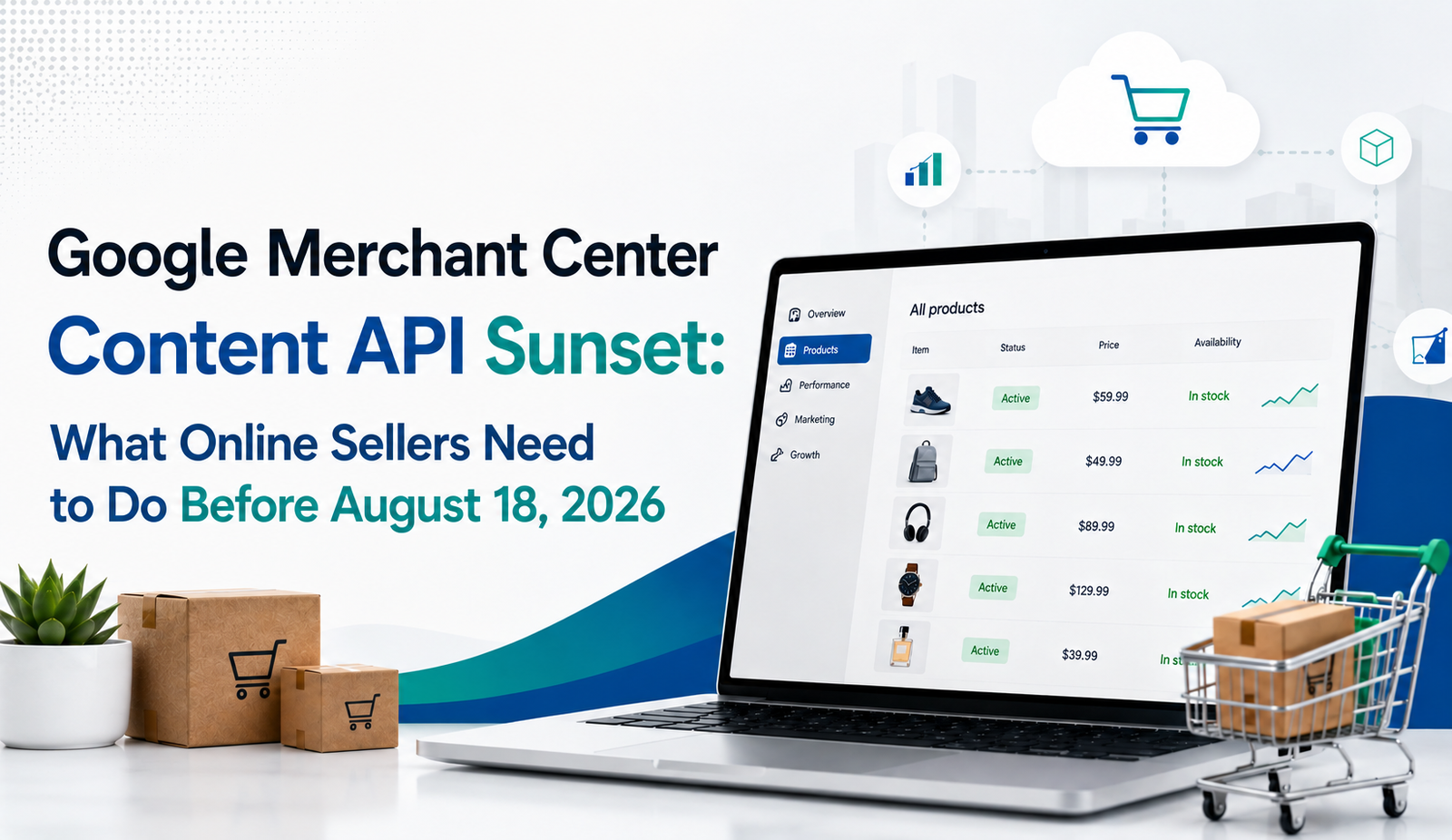
If you sell online and your product listings feed into Google Shopping, you’ve probably caught wind of “Google renamed Merchant Center” floating around over the past month or two. Honestly, that part barely matters. What actually matters and what seems to be getting lost under the branding noise is a separate deadline sitting quietly on August 18, 2026: the shutdown of the legacy Content API for Shopping.
One of these changes is cosmetic. The other can break your product listings without much warning if nobody’s watching for it.
Two Different Changes Got Mixed Up in the News Cycle
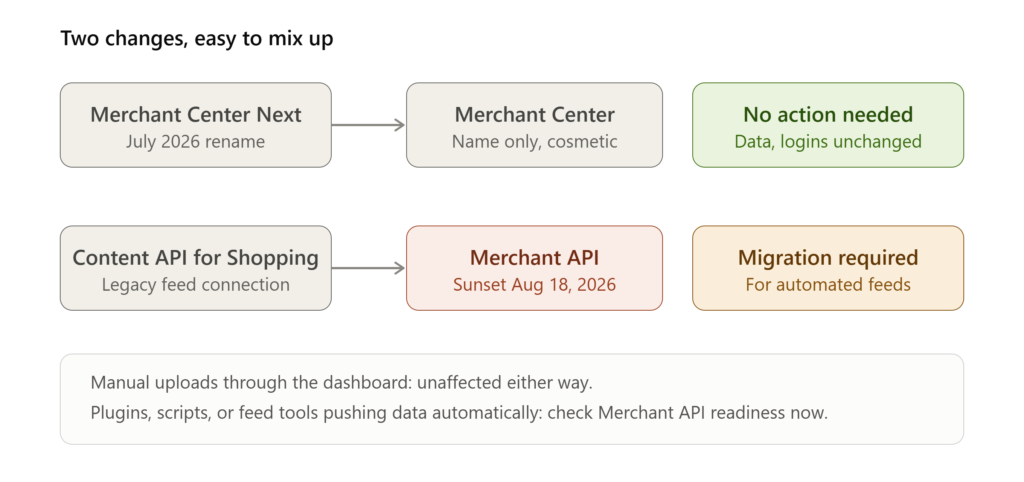
Back in July 2026, Google dropped the word “Next” from Merchant Center Next, so the platform’s just called Google Merchant Center now. That’s genuinely a naming cleanup, nothing more. Product data, campaigns, login credentials, saved bookmarks none of it changed. Google was pretty explicit that there was nothing to act on here.
Where it gets confusing is that this rebrand is easy to mix up with something far more consequential: the retirement of the Content API for Shopping, the older programmatic interface a lot of stores, agencies, and third-party feed tools have relied on for years to push product data into Merchant Center automatically. Google’s replacing it with a newer, modular system called the Merchant API, and the old one simply stops working on August 18, 2026.
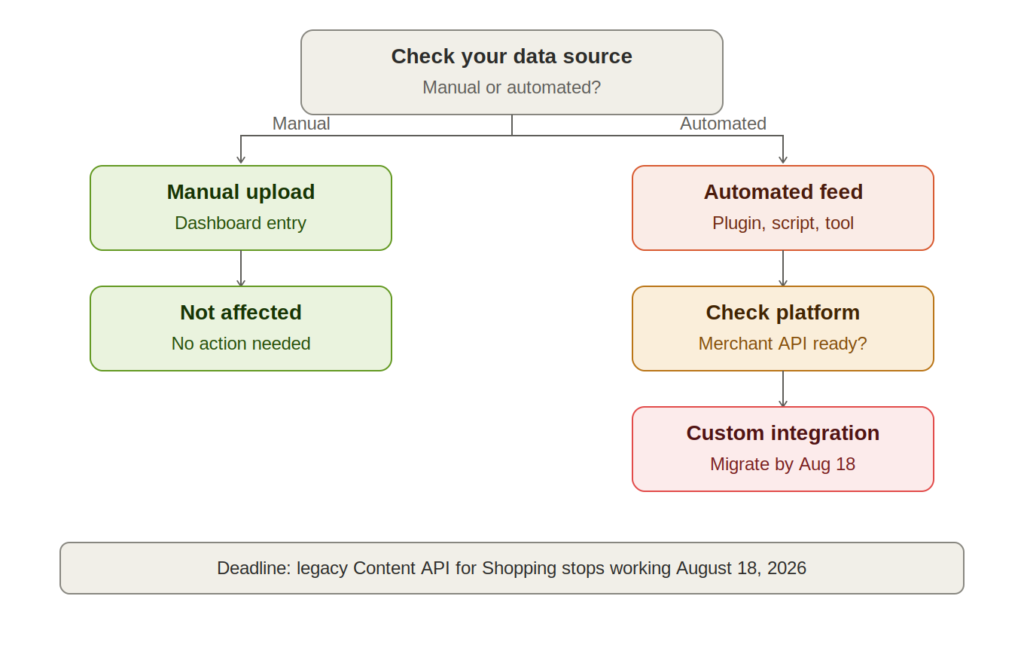
If your product data reaches Google purely through manual uploads or a standard data source feed, this deadline probably won’t touch you. But if a plugin, custom script, or feed management tool is quietly submitting your listings behind the scenes, this is the date you actually need to have on your radar.
Why This Matters More For Some Sellers Than Others
Most small stores managing a handful of products by hand through the Merchant Center dashboard won’t feel much of a difference at all. The real disruption lands on stores relying on automation ecommerce platforms with built-in Google Shopping integrations, custom-built feed scripts, agency-managed multi-account setups, anywhere product data flows into Merchant Center through code rather than a person clicking upload.
For those sellers, an unmigrated integration doesn’t slow down gradually. It just stops. Product listings can go stale or vanish from Shopping results entirely, and for a business running Performance Max or Shopping campaigns, that’s not a gentle dip in performance it’s an abrupt one, right when you least expect it.
What the Merchant API Actually Changes
The Merchant API isn’t a minor patch on the old system, it’s a structurally different approach. Where the Content API for Shopping handled broad functionality through one interface, the Merchant API splits things into modular sub-APIs covering specific areas like product data, inventory, promotions, and account management. That modularity is a deliberate design choice on Google’s part, meant to make future updates easier to roll out without breaking everything else connected to it. Google’s own documentation frames the Merchant API as the primary interface going forward for managing product data across both organic and ad experiences.
Practically, this also means new Merchant Center features going forward will be built exclusively on the Merchant API. Staying on the legacy system after August 18 isn’t really an option worth considering, since it means falling behind on both stability and access to newer tooling like Feed Intelligence Scoring and Product Studio’s AI-assisted product imagery.
What to Actually Do Before the Deadline
Start by figuring out how your product data currently reaches Google. If you’re on a major pe platform (Shopify, WooCommerce, Magento) with a native Google Shopping integration, check whether that platform has already handled the Merchant API migration on the backend, many have. If you’re using a third-party feed management tool, the same question applies: has the vendor confirmed Merchant API compatibility.
Where things get more hands-on is custom-built integrations, ones built in-house or by an agency specifically around the Content API. Those need a direct migration plan, and given the deadline is fixed, this isn’t something to leave for “later in the year.” Google Ads Scripts users in particular should treat this as an active migration task rather than a future cleanup item, since scripts tied to the old API don’t get a grace period once the sunset hits.
It’s also worth using this transition as a moment to actually clean up product data quality rather than just doing a like-for-like migration. Accurate titles, current pricing, complete attributes, and clear images all feed into how Google’s automated systems evaluate and rank product listings, and a migration is a natural checkpoint to fix long-standing feed issues that might have been quietly hurting visibility anyway.
The Bigger Pattern Worth Notici
This kind of shift of legacy infrastructure quietly sunset in favor of something more modular and AI-integrated isn’t really isolated to the Merchant Center. Google’s been steadily nudging advertisers and sellers toward structured, asset-based systems across Ads and Shopping generally, where clean data and proper tracking end up mattering more than manually configured settings ever did. Sellers who treat deadlines like this as routine maintenance, rather than a fire drill they discover too late, tend to come out ahead mostly because they’re not scrambling the week their listings quietly disappear.
Frequently Asked Questions
Do I need to do anything if I only upload products manually to the Merchant Center? Not for this specific deadline. The Content API sunset only affects stores pushing product data through a programmatic connection. Manual uploads and standard data source feeds aren’t affected.
Is the Merchant Center rebrand related to the Content API shutdown? No, they’re unrelated. The name change from “Merchant Center Next” to “Merchant Center” is purely cosmetic. The Content API sunset on August 18, 2026 is a genuine technical deadline requiring migration for anyone using it.
What happens if I don’t migrate before August 18? Any integration still relying on the legacy Content API will stop working once it’s retired, which can cause product listings to go stale or drop out of Google Shopping results, directly affecting Shopping and Performance Max campaign performance.
How do I know if my store is affected? Check with your ecommerce platform or feed management tool about Merchant API compatibility. If your product data flows into the Merchant Center through a custom script or in-house integration, that needs a direct migration plan before the deadline.
Final Thought
Deadlines like this rarely announce themselves loudly enough. A rebrand grabs headlines; a quiet API sunset doesn’t, which is exactly why it’s worth double-checking rather than assuming someone else already handled it. A few minutes confirming whether your feed integration is Merchant API-ready now beats troubleshooting disappearing listings on August 19.
For businesses managing product feeds and Shopping campaigns, staying ahead of platform changes like this is part of ongoing ecommerce and paid media work at Medowa Global.