If you’ve noticed your search ad performance behaving a little differently lately, you’re not imagining it. At Google Marketing Live 2026, Google introduced a new generation of AI-powered ad formats built specifically for AI Mode and conversational search and they work nothing like the ads you’re used to managing.
For businesses running paid search campaigns, this isn’t a minor update. It’s a shift in where ads appear, how they’re built, and what “winning” a placement even means.
What's Actually Changing
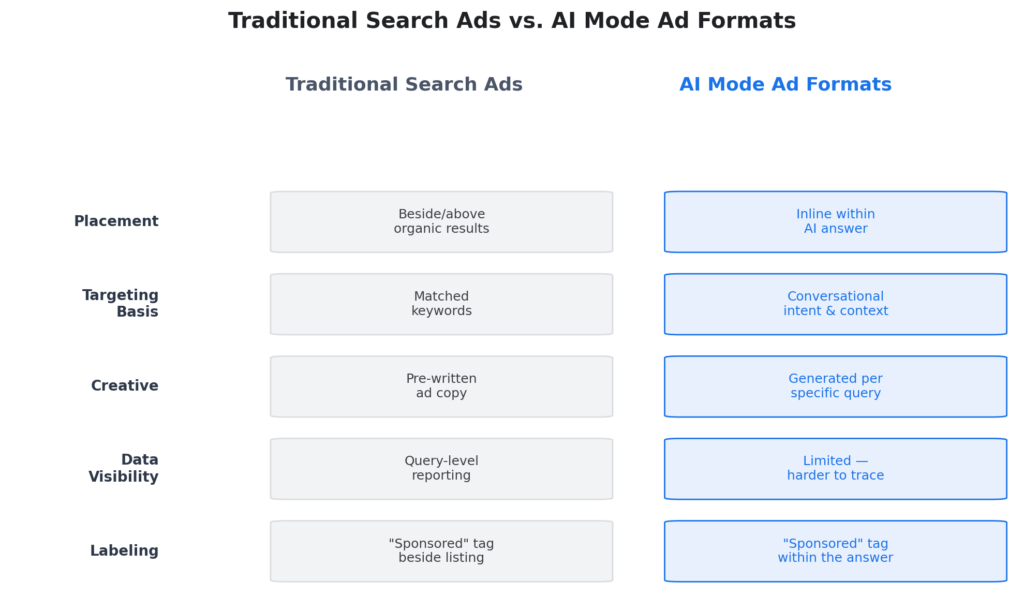
Search used to work in a fairly predictable way: someone types a query, sees a results page, and ads sit clearly labeled alongside organic listings. That structure is starting to break apart inside AI Mode, where answers are generated conversationally rather than displayed as a list of links and Google confirmed the shift at Google Marketing Live 2026, unveiling formats built specifically for that new environment.
Conversational Discovery Ads
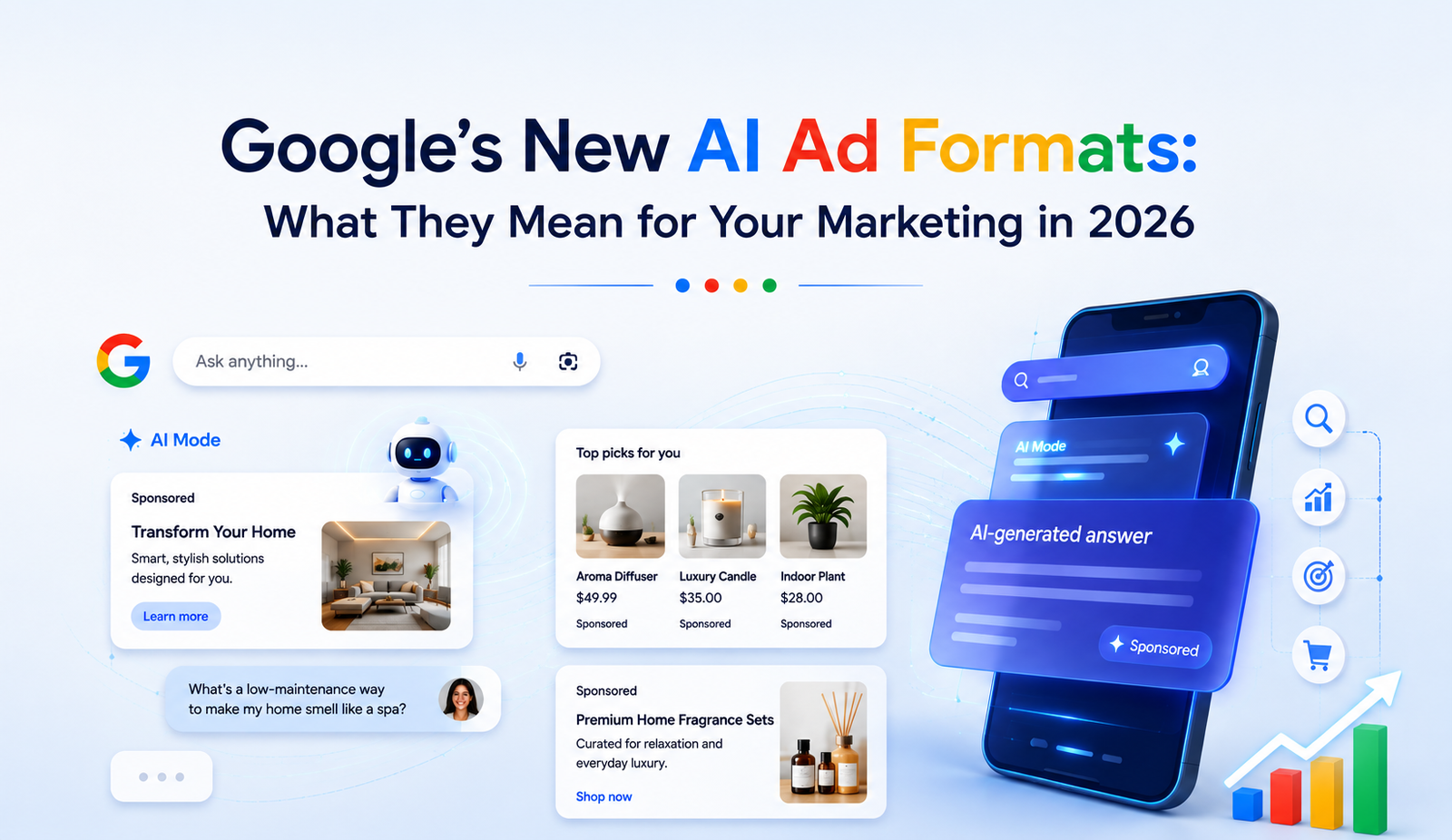
These ads respond directly to a specific, detailed question inside an AI Mode conversation. Someone asking something like “what’s a low-maintenance way to make my home smell like a spa” could see custom ad creative generated in response built around their exact query rather than a matched keyword. The ad isn’t sitting beside the answer anymore. In a real sense, it’s becoming part of the answer.
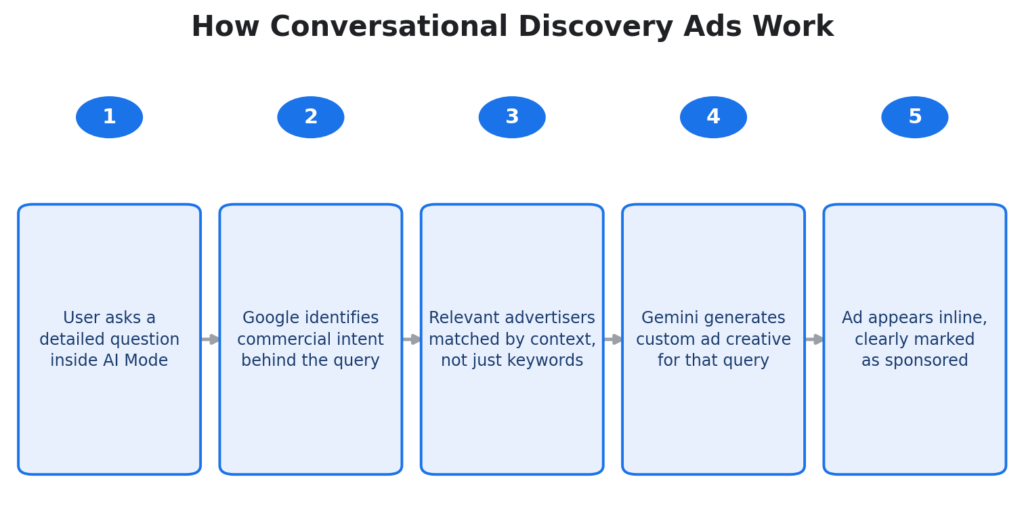
How it plays out, step by step:
- A user asks a detailed, specific question inside AI Mode
- Google identifies commercial intent behind the query
- Relevant advertisers are matched based on context, not just keywords
- Gemini generates custom ad creative tailored to that exact question
- The ad appears inline within the conversation, clearly marked as sponsored
Highlighted Answers
This format shows up when someone’s searching for a recommendation, the best option among several choices, for instance. Google generates a curated list of suggestions, and a business can appear in that list if it’s genuinely relevant. Every sponsored entry stays clearly labeled, but the placement itself sits inside a recommendation format rather than a traditional ad slot.
AI-Powered Shopping Ads
For higher-consideration purchases, Google is also rolling out shopping ads that include AI-generated explainers, essentially a short, automatically written case for why a particular product fits what the shopper is looking for.
Why This Matters More Than It Sounds
It’s tempting to file this under “another Google update” and move on. We’d push back on that a little. A few things make this shift worth paying real attention to.
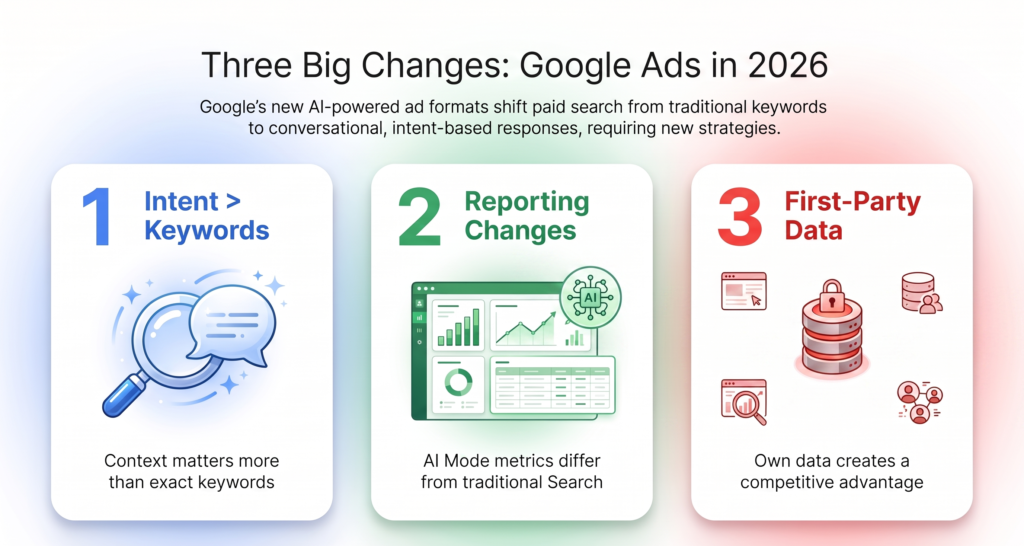
Three shifts worth watching:
- Targeting – keyword matching is losing ground to intent and context
- Reporting – AI Mode impressions behave differently, expect noisier data short-term
- Data trail – conversational queries are harder to trace than single searches
Keyword targeting is losing ground to intent targeting. Google has been drifting this direction for years through broad match and smart bidding, but AI Mode placements speed it up considerably. Audience signals, page context, and creative quality are becoming bigger performance levers than exact keyword matching ever was.
Reporting is going to look messier before it looks clearer. Impressions inside AI Mode don’t behave like traditional search-results impressions, so comparing this quarter’s numbers to last quarter’s isn’t quite apples to apples yet. It’s generally worth waiting for a clean 60 to 90 days of post-launch data before drawing conclusions early anomalies are more likely a placement-mix shift than an actual performance change.
The data trail is getting harder to follow. Someone who asks a follow-up question two or three turns into an AI Mode conversation leaves a much messier path to trace than a single search-and-click. Businesses with solid first-party data tracking that doesn’t lean entirely on Google’s own reporting are going to have a real structural advantage here over those relying purely on platform-level numbers.
What Small and Medium Businesses Should Actually Do
None of this means existing campaigns need to be torn up overnight. It does mean it’s worth starting to test deliberately rather than waiting for AI Mode traffic to become unavoidable.
A sensible starting point looks like this: opt into AI Mode placements through a separate test campaign rather than folding them into existing ones, so performance can be measured in isolation. Resist comparing AI Mode metrics directly against traditional search metrics for now the underlying user behavior is different enough that it deserves its own baseline. And where possible, start strengthening first-party data collection now, since query-level visibility inside conversational search is only likely to get thinner over time.
For businesses that rely heavily on visibility inside high-intent, question-style searches, these formats are also worth watching closely from a content standpoint. Google has said sponsored picks will always stay clearly labeled, which is a meaningful transparency signal as advertising moves deeper into conversational surfaces, something regulators in several markets have been pushing for as AI-generated content becomes more common in advertising overall.
Frequently Asked Questions
Are Conversational Discovery ads live for everyone right now? Not yet. As of mid-2026, Google has these formats in testing within AI Mode on mobile and desktop in the U.S., with wider availability expected to follow as testing wraps up.
Will these AI-generated ads be clearly marked as ads? Yes. Google has confirmed that sponsored placements inside AI Mode, including Highlighted Answers and Conversational Discovery ads, will carry clear sponsored labels.
Do I need to change my current Google Ads campaigns immediately? No immediate overhaul is needed. The more practical move is testing these formats in isolated campaigns while keeping proven campaigns running as they are.
How is this different from Google’s Performance Max? Performance Max automates placement across Google’s network with limited visibility into where ads run. These new formats are specifically built for conversational, AI Mode search experiences, which is a narrower and newer surface entirely.
Why does first-party data matter more with these new formats? As conversations replace single searches, less query-level detail is likely to be visible to advertisers. Businesses with their own tracking connecting ad exposure to actual revenue rather than relying solely on platform reporting will have clearer visibility into what’s actually working.
Final Thought
What’s really happening here is that the boundary between “search,” “AI answers,” and “ads” is dissolving into a single experience. For marketers, that means creative quality, audience data, and genuine relevance are starting to matter more than they ever did in a pure keyword-matching world.
Ad formats will keep changing, and Google will keep testing new ways to make search feel more conversational. What doesn’t change is that campaigns still need to be built around real intent, clean data, and creativity that actually earns attention. Medowa Global Ventures has been tracking this shift closely and helping businesses adjust their paid search approach as it unfolds.