The way users discover content is evolving—and so are the tools we need to track it. Microsoft has officially launched the AI Performance report in Bing Webmaster Tools (Public Preview, February 2026), giving publishers a first-of-its-kind window into how often—and where—their content is cited in AI-generated answers across Copilot, Bing AI summaries, and partner experiences.
If you’re creating content today, this isn’t just another analytics dashboard. It’s your early signal for Generative Engine Optimization (GEO): understanding what AI systems trust, reference, and surface to users.
In this post, we’ll break down what the AI Performance report measures, how to access it, and actionable ways to use these insights to future-proof your content strategy.
What Is the AI Performance Report?
The AI Performance Report is a new, dedicated dashboard inside Bing Webmaster Tools designed to help publishers and SEO professionals understand how their content performs in the age of AI-driven search.
Simply put, it shows where and how often your content is cited as a source in AI-generated answers across Microsoft’s AI ecosystem, including:
🔹 Microsoft Copilot – AI assistant responses
🔹 Bing AI Summaries – Overview boxes and snapshot answers in search results
🔹 Select Partner Integrations – Third-party experiences powered by Bing’s AI infrastructure
Why This Matters
Until now, tracking visibility in AI-generated results has been largely guesswork. With this report, Microsoft provides one of the first official, platform-native tools to measure AI visibility—a critical metric for Generative Engine Optimization (GEO).
GEO in a nutshell: Just as SEO helps your content rank in traditional search, GEO focuses on making your content cite-worthy for AI systems that synthesize answers from multiple sources.
What You Can Expect to See
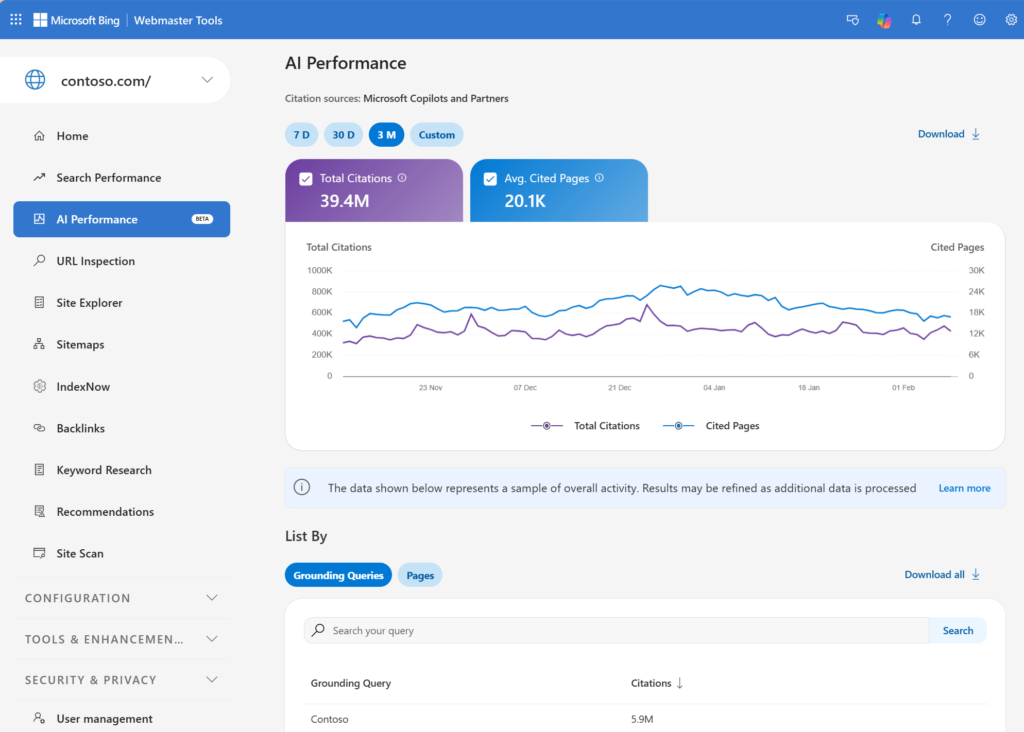
While the report is in Public Preview, early access reveals insights like:
- Which of your pages are being referenced by AI models
- The queries that triggered citations of your content
- Trends in citation volume over time
- Comparative visibility across different AI surfaces
This isn’t about replacing traditional SEO metrics—it’s about adding a new layer of intelligence to your content strategy as user behavior shifts toward conversational, AI-powered search.
Key Metrics Included
Total Citations
Number of times your site is cited as a source in AI-generated answers during a selected period
Average Cited Pages
Daily average of unique URLs from your site referenced across AI experiences
Grounding Queries
Sample query phrases AI systems use to retrieve and cite your content
Page-Level Citation Activity
Citation counts by URL, highlighting which pages are referenced most often
Visibility Trends Over Time
Timeline view showing how citation activity rises or falls across AI experiences
How to Use These Insights
- Validate which pages are already being used as references in AI answers
- Identify content that appears frequently across AI-generated responses
- Spot opportunities to improve clarity, structure, or completeness on less-cited pages
How to Access the AI Performance Report
Getting started is simple:
- If your site is already verified in Bing Webmaster Tools, just log in and look for the new “AI Performance” section in your dashboard.
- No extra configuration, tags, or permissions are needed—your existing verification is all it takes.
- Data begins populating automatically once the feature is enabled for your property.
⏱️ Note: As a Public Preview feature, availability may roll out gradually. If you don’t see it yet, check back in a few days or ensure your Webmaster Tools account is up to date.
Why This Launch Matters
With the AI Performance report, Microsoft takes a leading step in bringing transparency to AI-driven content discovery. While other platforms are still exploring how to attribute source usage in generative answers, Bing is giving publishers:
- Early visibility into how AI systems reference their content
- Actionable signals to refine content for AI citation (GEO)
- A foundation for trust—showing creators they can measure impact beyond traditional clicks
For SEOs, content strategists, and digital publishers, this isn’t just a new metric—it’s a new dimension of search intelligence. As AI answers become a primary way users find information, understanding citation visibility may soon be as critical as ranking position.
Stay Ahead in the AI Search Era
The launch of the AI Performance report in Bing Webmaster Tools marks a pivotal moment for content creators and SEO professionals. For the first time, you have a native, data-driven way to see how your content performs in AI-generated answers—across Copilot, Bing AI summaries, and partner experiences.
While still in Public Preview, this tool offers an early advantage:
- Understand what content AI systems trust and cite
- Identify opportunities to strengthen your GEO strategy
- Future-proof your visibility as search evolves beyond traditional links
Don’t wait for AI search to become the norm—start measuring, learning, and optimizing today.