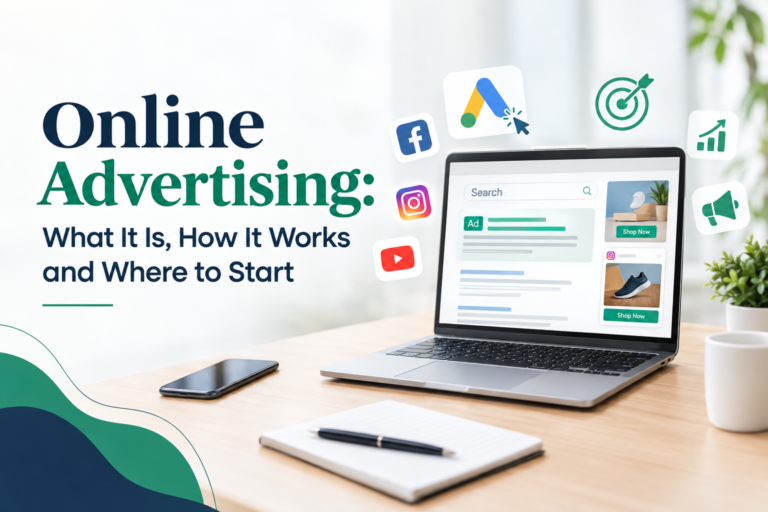
Every business wants to be seen by people who are ready to buy. Online advertising is one of the fastest ways to get in front of them, because you pay to place your message where your customers already spend their time: search engines, social feeds, video platforms and websites.
But “just run some ads” is where many first campaigns go wrong. In this guide, we explain what online advertising is, how it works behind the scenes, the main types, and the mistakes that quietly drain budgets.
What Is Online Advertising?
Online advertising, also called digital advertising, is the practice of promoting a product, service or brand through paid placements on internet-based platforms. These can be text ads on a search results page, image ads on a website, video ads before a clip, or sponsored posts in a social feed.
The key word is “paid”. Unlike organic marketing such as SEO or regular social posting, you are buying visibility. In return, you get speed and control over who sees your message, when and where.
How Online Advertising Works
Behind every ad you see, there is a quick, automated process.
The Ad Auction
When someone opens a page or runs a search, the platform runs an auction in milliseconds. Advertisers who match the audience or keyword compete for the slot. The winner is not always the highest bidder. Platforms also weigh ad quality, relevance and the expected experience after the click.
Targeting
Targeting decides who sees your ad. You can choose by location, age, language, interests, search keywords, device or past behaviour on your website. The tighter your targeting matches your real customer, the less money you waste.
Tracking and Optimisation
Platforms report impressions, clicks and conversions. You use this data to pause weak ads, increase budget on strong ones and refine your audience. Advertising is rarely right on the first attempt. It improves through testing.
Types of Online Advertising
Different formats suit different goals. Here are the main ones.
Search Ads
These appear when someone types a query into a search engine. Because the person is already looking for something, intent is high. Search ads work well for services, local businesses and products people compare before buying. You can learn how the platform itself describes the process in Google Ads Help.
Social Media Ads
Facebook, Instagram, LinkedIn, YouTube and other platforms let you show ads based on interests and behaviour. People are not searching here, so the creative has to catch attention quickly. Meta’s advertising overview explains the formats and objectives available.
Display Ads
Banner and image ads appear across websites and apps. They are better for awareness and reminding people about your brand than for immediate sales.
Video Ads
Short or long video placements on YouTube, social platforms and streaming apps. Video suits storytelling and product demonstrations.v
Retargeting Ads
These reach people who already visited your website or engaged with your brand. They tend to convert better because the audience already knows you. If this interests you, our guide on retargeting and remarketing ads covers the setup in detail.
Native and Shopping Ads
Native ads match the look of the page they appear on, while shopping ads show product images, prices and store names directly in results. Both are strong for ecommerce.
Common Pricing Models
Understanding how you pay helps you control your budget.
- CPC (cost per click): you pay when someone clicks
- CPM (cost per thousand impressions): you pay for visibility, not clicks
- CPA (cost per acquisition): you pay when a defined action happens, such as a lead or sale
- CPV (cost per view): common in video, where you pay for a view
No model is automatically best. CPC suits lead generation, CPM suits awareness, and CPA suits businesses with clear conversion tracking.
Benefits of Online Advertising
- Fast results: campaigns can go live within a day
- Measurable: you can see what each rupee or dirham produced
- Flexible budgets: you can start small and scale as results come in
- Precise targeting: you reach specific people rather than everyone
If you are deciding how to split spend across platforms, our breakdown of Google Ads vs Meta Ads budget allocation is a useful next read.
Challenges You Should Expect
Online advertising is powerful, but it is not effortless.
- Rising competition: more advertisers in the same auction can push costs up
- Ad fatigue: audiences stop noticing creative they have seen repeatedly
- Privacy changes: tracking limits mean attribution is less perfect than it used to be
- Weak landing pages: a good ad cannot fix a confusing website
- Changing formats: platforms keep introducing AI-led placements, as we covered in Google’s new AI ad formats
Most of these problems are manageable with steady testing, clear goals and a landing page that matches the promise of the ad.
How to Get Started With Online Advertising
- Define one goal. Leads, sales or awareness. Pick one.
- Know your customer. Write down who they are, what they search for and what worries them.
- Choose one or two platforms. Do not spread a small budget across five.
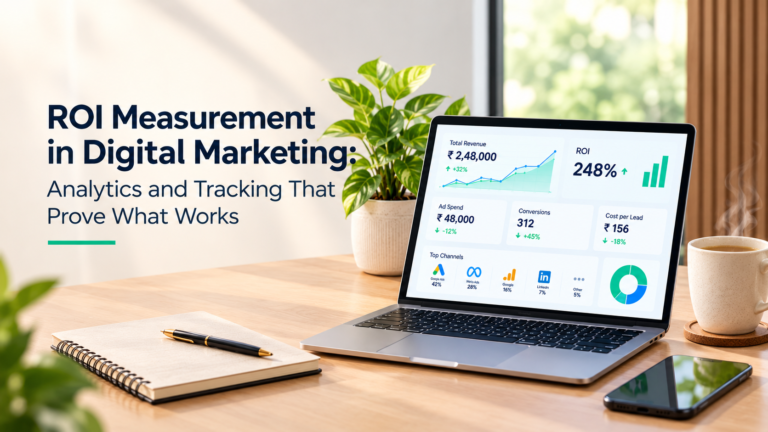
- Set up tracking first. Install conversion tracking before spending anything, and decide how you will judge ROI in digital marketing.
- Write clear creative. Say what you offer, who it is for and what to do next.
- Review weekly. Pause weak ads, test new headlines and adjust budgets based on actual conversions.
Frequently Asked Questions
What is online advertising in simple words?
It is paying to show your business message to people on the internet, through search results, social media, websites or videos.
What is the difference between online advertising and digital marketing?
Digital marketing is the wider field and includes SEO, email, content and social media. Online advertising is the paid part of it.
How much should a small business spend on online advertising?
There is no fixed number. Many businesses start with a small monthly budget, test for a few weeks, and increase spend only on campaigns that bring measurable enquiries or sales.
Which type of online advertising is best for beginners?
Search ads are often a good starting point because they reach people who are already looking for what you offer.
How long does it take to see results?
You can see clicks and leads within days. Stable, profitable performance usually takes a few weeks of testing and optimisation.
Is online advertising better than SEO?
They do different jobs. Ads give quicker visibility while SEO builds longer-term traffic. Most businesses benefit from using both.
Closing
Online advertising works best when it is treated as a system: clear goals, the right audience, honest messaging and regular review. Start small, measure properly and scale what works. If you would like help planning campaigns that connect to real business results, our team at Medowa Global is happy to help.