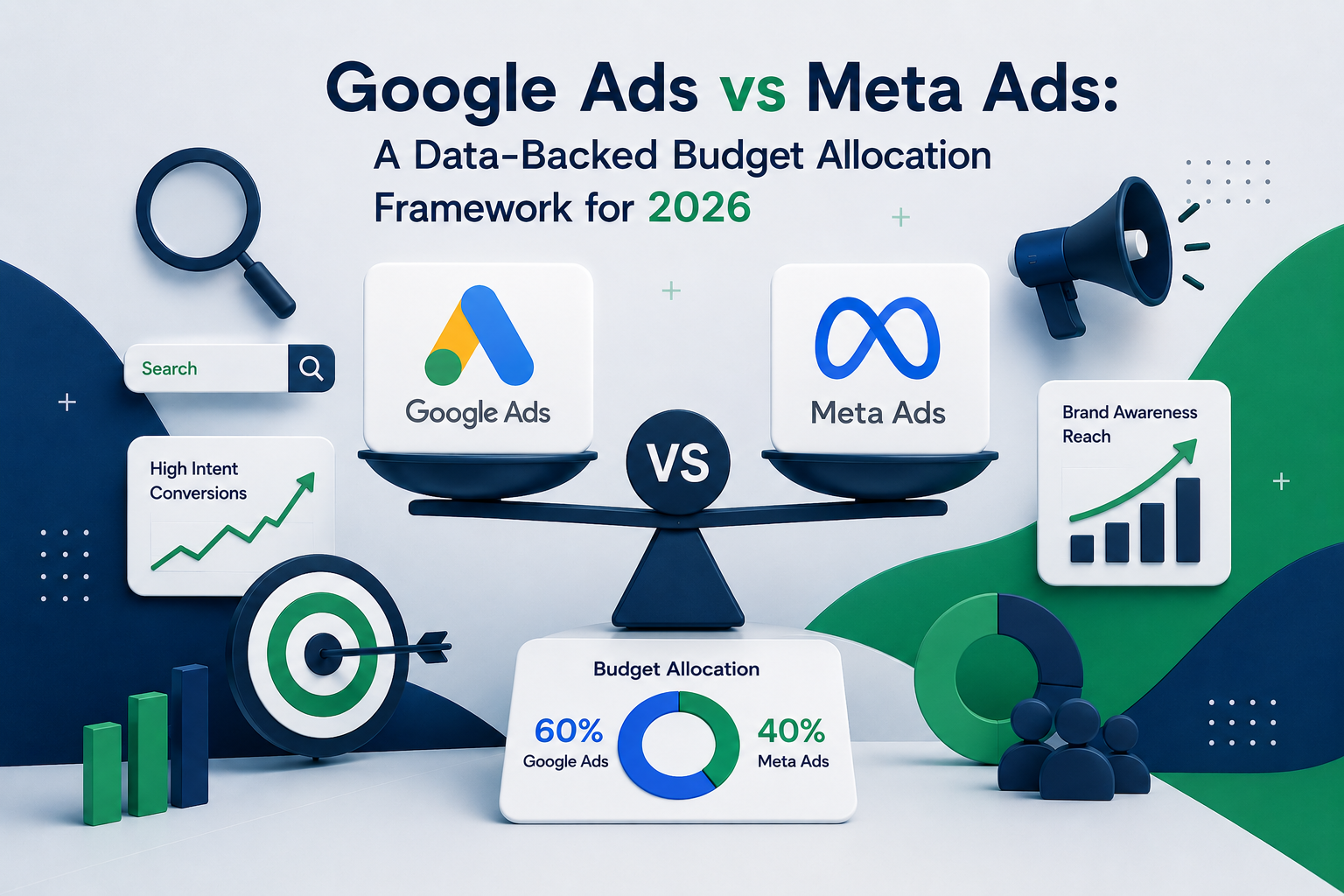
“Should we put more into Google or Meta this month?” We get asked this almost every time we sit down with a new client, and honestly, there’s no single right answer. Anyone who hands you a flat 60/40 rule without first asking about your industry is guessing. The real split depends on what you sell, how long people take to decide, and what each platform is genuinely good at. The good news is that 2026 finally gives us enough real cost and conversion data to stop guessing and build a framework you can actually defend in a budget meeting.
Why the Google vs Meta Debate Looks Different in 2026
Ad costs have shifted quite a bit on both platforms this year. According to 2026 benchmark data from WordStream, Google Search clicks now average $4 to $5, up sharply from last year. Meta clicks have stayed cheaper, sitting closer to $0.60 to $1. Look at those two numbers side by side and Meta seems like the obvious winner. But cost per click is only half the story, and it’s the half that gets people into trouble.
Here’s the part that actually matters: conversion behaviour. Google traffic converts at roughly 3 to 4 percent because people are typing in exactly what they want. Meta traffic converts at under 1 percent because most people are scrolling, not shopping, when your ad shows up. Run those numbers through to cost per acquisition and the gap between the two platforms shrinks fast. Google often comes out ahead on actual cost per customer, even with the pricier clicks.
So the real lesson isn’t “Meta is cheap” or “Google is expensive.” It’s that a cheap click that never converts costs you more than an expensive one that does. Base your split on cost per outcome, not cost per click.
What Each Platform Is Actually Built to Do
Google Ads: Catching People Who Already Want Something
Google works because it catches intent that already exists. Someone typing “3 BHK apartment in Trivandrum” or “gold rate today Kerala” has already decided they need something, and your ad just needs to be there at the right second. That’s why Google usually owns the bottom of the funnel for big-ticket, high-consideration purchases like real estate, financial services, and home renovation.
Meta Ads: Creating Demand That Doesn't Exist Yet
Meta plays a completely different game. Nobody’s searching for you on Instagram, so the platform’s real job is to interrupt someone’s feed and make them remember you exist. That’s exactly why it works so well for awareness, retargeting, and warming up leads through project walkthroughs, client testimonials, and short videos, usually at a fraction of what the same lead would cost on Google.
Industry Benchmarks That Should Shape Your Split
Real Estate
Real estate is one of the rare categories that genuinely performs well on both platforms at once. Meta click-through rates for real estate campaigns sit comfortably above the all-industry average, which makes it a strong top-of-funnel channel for property showcases and virtual tours. Google, meanwhile, keeps capturing the buyers who are ready to book a site visit right now. A blended split, around 55 to 60 percent Google and 40 to 45 percent Meta, tends to work well here. If you’re a smaller developer going up against bigger brands, pairing this with local visibility tactics means your paid and organic budgets start pulling in the same direction instead of competing with each other.
Finance
Finance is the most expensive category on both platforms, and there’s a clear reason why. Compliance restrictions and lower trust in financial ads shown inside a social feed push costs up everywhere. Meta clicks for finance run well above the platform average, and Meta’s acquisition costs for financial services can climb far higher than Google’s. If you’re managing a finance client, lean Google, closer to 65 to 70 percent, and keep Meta for brand awareness and retargeting people who’ve already visited the site once.
Home Renovation and Villa Projects
Renovation is a slow-burn purchase, and that plays right into Meta’s strengths. Before-and-after photos, video walkthroughs, and client testimonials do well in-feed and keep you top of mind while someone’s still deciding whether to commit. Google steps in once they’re actively comparing contractors and typing in searches. A near-even split, around 50/50, with more of the Meta budget going toward video, usually produces the best cost per lead here.
A Practical Framework for Splitting Your Budget
Start with a 70/30 baseline. No historical data yet? Put 70 percent into Google Search and 30 percent into Meta. It’s a safe starting point that keeps you from overspending on an unproven audience.
Track cost per acquisition, not cost per click. CPC comparisons across platforms will mislead you every time. What matters is what it actually costs to get a lead or a sale.
Calculate marginal ROAS, not just average ROAS. A campaign can look great on average while its next rupee of spend earns you almost nothing extra. Check the incremental return before you scale any budget up.
Rebalance every 30 to 60 days, based on what the data says, not what you assumed going in. New accounts usually need a full 60 days before the numbers are reliable enough to act on.
Common Mistakes to Avoid
- Judging platforms purely on CPC. A cheap click that never converts costs more than an expensive one that does.
- Ignoring the funnel stage. Sending cold Meta traffic straight to a lead form rarely works. Warm the audience up first, then retarget on Google Search.
- Keeping poor performers alive too long. A surprising share of ad budget just sits in underperforming campaigns because nobody went back and reviewed the split.
- Treating attribution as solved. Privacy changes have made cross-platform tracking harder than it used to be. First-party data and server-side tracking matter more now than they did a year ago.
How AI Automation Is Changing Budget Decisions
Both platforms have leaned harder into automation this year. Google’s Performance Max now optimises across Search, Shopping, Display, and YouTube from one shared budget, and Meta’s Advantage+ handles targeting, creative rotation, and bidding with a lot less manual input than before. We covered how these AI-driven formats are reshaping campaign setup in our earlier post on Google’s new AI ad formats and what they mean for your marketing. None of this removes the need for a budget strategy though. It just moves the decision one level up: instead of setting individual bids, you’re now deciding how much total budget each automated system gets to work with, then letting it optimise inside that limit.
Frequently Asked Questions
What is a good starting budget split between Google Ads and Meta Ads? A 70/30 split favouring Google Search is a safe starting point if you don’t have prior data. Adjust it after 60 days once your cost per acquisition numbers settle in.
Is Meta Ads cheaper than Google Ads in 2026? Meta’s cost per click is lower, usually under $1 against $4 to $5 on Google. But Google’s higher conversion rate often makes its cost per acquisition just as competitive, sometimes even lower, depending on the industry.
Which platform is better for real estate and finance brands? Real estate does well on both and benefits from a near-even split. Finance usually does better weighted toward Google, closer to 65 to 70 percent, because Meta’s acquisition costs run high in that category.
How often should I rebalance my ad budget between platforms? Every 30 to 60 days. Shift budget based on marginal ROAS and actual cost per acquisition, not on habit or last year’s numbers.
Final Thoughts
There’s no single “correct” Google-to-Meta ratio out there waiting to be discovered. What actually works is picking a sensible starting point, watching the right metrics, and adjusting the split based on what your own data tells you month after month. For real estate, finance, and renovation brands, the patterns above are a solid place to start, but the split that really wins will always be the one built from your own campaign performance over time.
If your current budget doesn’t match these benchmarks, or you’re wondering how AI Overviews are affecting your paid and organic results together, our earlier piece on what Google’s AI search data means when evaluating a digital marketing agency is worth reading next. Otherwise, pulling your last 90 days of Google and Meta spend and running it through this framework is the fastest way to see exactly where you stand, or if you’d rather have a second pair of eyes on the split, Medowa Global can walk through your account with you.