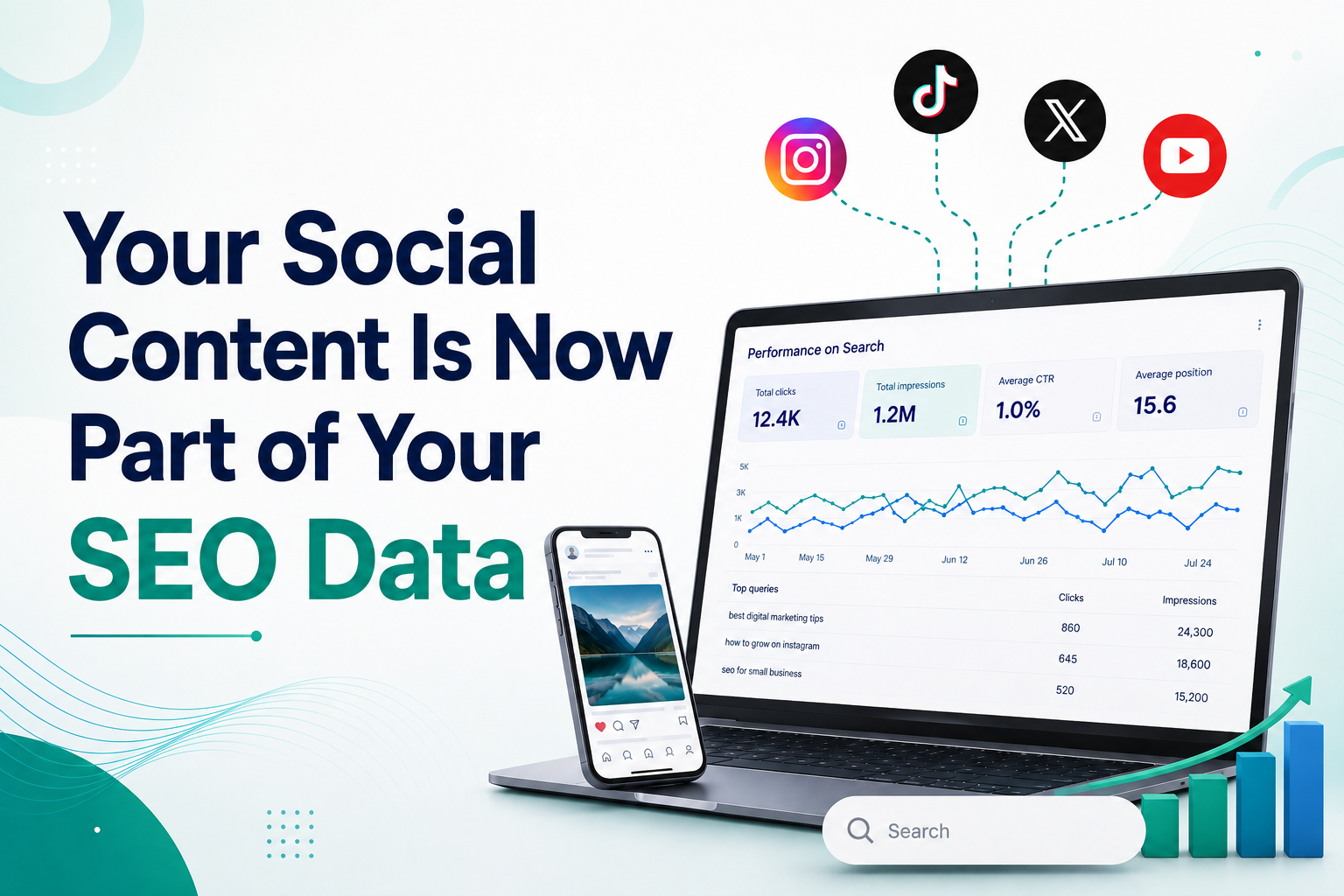
Most businesses run two separate scoreboards without really thinking about it. One tracks how the website does in Google Search, clicks, impressions, keyword rankings. The other tracks how social content does, likes, shares, watch time, follower growth. Nobody’s really at fault here; the two just never had a reason to talk to each other. But they’re both measuring the same thing at the end of the day: whether the right people are finding you.
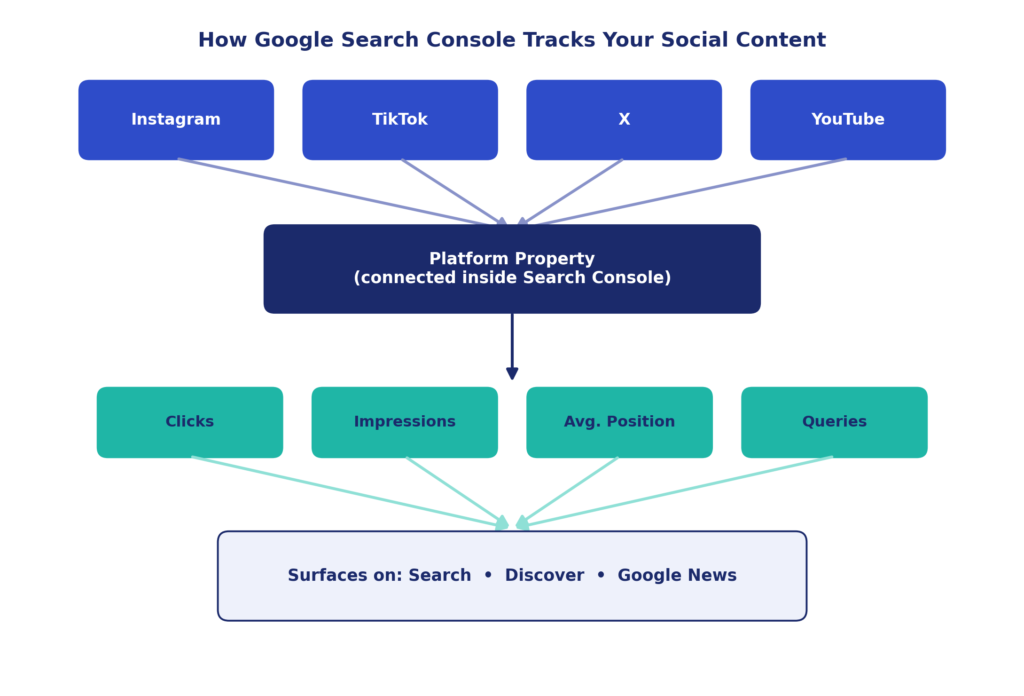
That gap closed a bit in July 2026, when Google rolled out something called platform properties inside Search Console. It lets brands connect their Instagram, TikTok, X, and YouTube accounts, and for the first time, see how that content actually performs on Google’s own turf, Search, Discover, and Google News.
It’s easy to skim past this as another minor feature update. It isn’t. It’s Google telling businesses, fairly directly, that social content now counts the same way a webpage does. Ignore it, and you’re only seeing half of what’s actually working for you.
What This New Data Actually Shows
Once you connect a platform property, Search Console starts reporting on it the same way it reports on a website, clicks, impressions, average position, and the exact queries people typed before they ended up on your content.
That opens up a few questions businesses simply couldn’t answer a year ago:
- Is a specific Reel showing up when someone searches something related on Google, not just inside Instagram’s own app?
- What did someone actually search before a YouTube video showed up for them?
- Is a TikTok post from four months ago still quietly pulling in search impressions?
- Are your X posts turning up inside Google News for your industry?
None of that data existed anywhere before this. Platform analytics only ever told you how people engaged once they were already on the platform. They never told you whether Google was putting your content in front of someone actively searching for it.
Why This Should Matter Beyond the Marketing Team
It’s tempting to file this under “another Search Console update” and move on with your day. That would be missing the point.
If a Reel keeps showing up for a search query, it’s not just a social win anymore, it’s functioning as an organic search asset. Same job as a blog post, just arriving in a different format. Treating that content as disposable, the way most social calendars still do, means throwing away traffic that’s already working for you.
There’s a content-planning shift hiding in here too. A caption written purely to perform inside Instagram doesn’t always match how someone actually phrases a Google search. But content built around a real, specific query, a product name, a “how to,” a comparison people genuinely search for, has a shot at showing up in both places at once: the feed, and the results page. That changes how a content calendar should get built in the first place, not as an afterthought, but with search intent baked in from day one.
How to Actually Use Platform Properties
Having the data is only useful if it changes what you do next.
Connect every active social account as a platform property. This has to be set up manually inside Search Console, it doesn’t happen on its own just because a business profile exists on Instagram or YouTube. Google’s own Search Console Help documentation covers property setup and verification if you’re doing this for the first time.
Check the Queries report regularly, the same way you’d check it for your website. It shows you the exact language people used before landing on a post or video, which often surfaces search intent you weren’t even targeting on purpose.
Turn your best-performing social content into a full page. If a video keeps generating Search impressions for a specific topic, that topic probably deserves a proper blog article too, something that gives Google more to work with.
Stop reporting on social media and search like they’re unrelated. A single combined view of what’s actually reaching people, across every format you publish in, tells a far more honest story than either report on its own.
A Bigger Pattern Worth Noticing
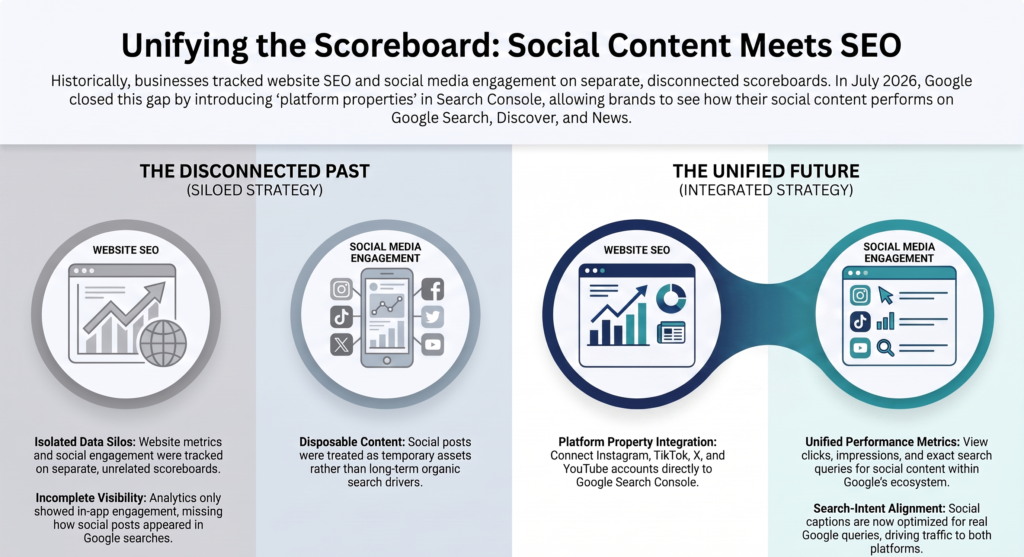
This fits into something larger playing out across search this year. Google’s been steadily blurring the line between “website SEO” and everything else a brand publishes, AI Overviews citing social posts, Discover surfacing video, and now platform properties tying it all together under one roof.
Businesses still treating social media and SEO as separate departments with separate reports are working off an incomplete picture. The ones paying attention to how Google is actually connecting the two will be the ones who spot the opportunities everyone else misses.
FAQ
Do I need a certain number of followers to set up a platform property?
No. Any business account on Instagram, TikTok, X, or YouTube can be connected. There’s no follower or engagement threshold.
Does this replace Instagram, TikTok, or YouTube’s own analytics?
No. It sits on top of what those platforms already show you as a Google-visibility layer. Both are worth checking regularly, they answer different questions.
Does performing well in Search Console mean the content will also do better on the platform’s own algorithm?
Not necessarily. Platform properties measure visibility on Google’s surfaces specifically, not the ranking logic of Instagram, TikTok, or YouTube itself.
Is this available for every business right now?
Yes, the rollout applies broadly. You just need to set up the connection manually inside the Search Console.
Final Thought
Social and search have quietly turned into the same conversation. The businesses that start keeping score on both together are the ones who’ll actually understand where their visibility is coming from, and where it’s headed next.
At Medowa Global, this is exactly the kind of shift we keep a close eye on, connecting the dots between search and social so businesses aren’t stuck reading half the scoreboard. If you’re ready to see how your content is actually performing across both, medowaglobal.com is a good place to start that conversation.