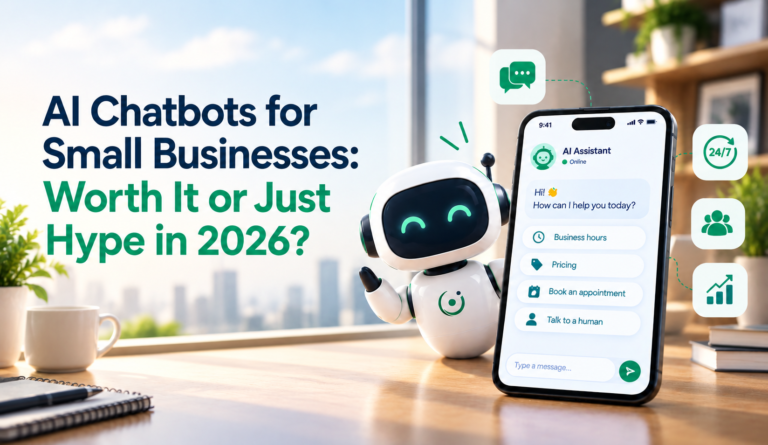
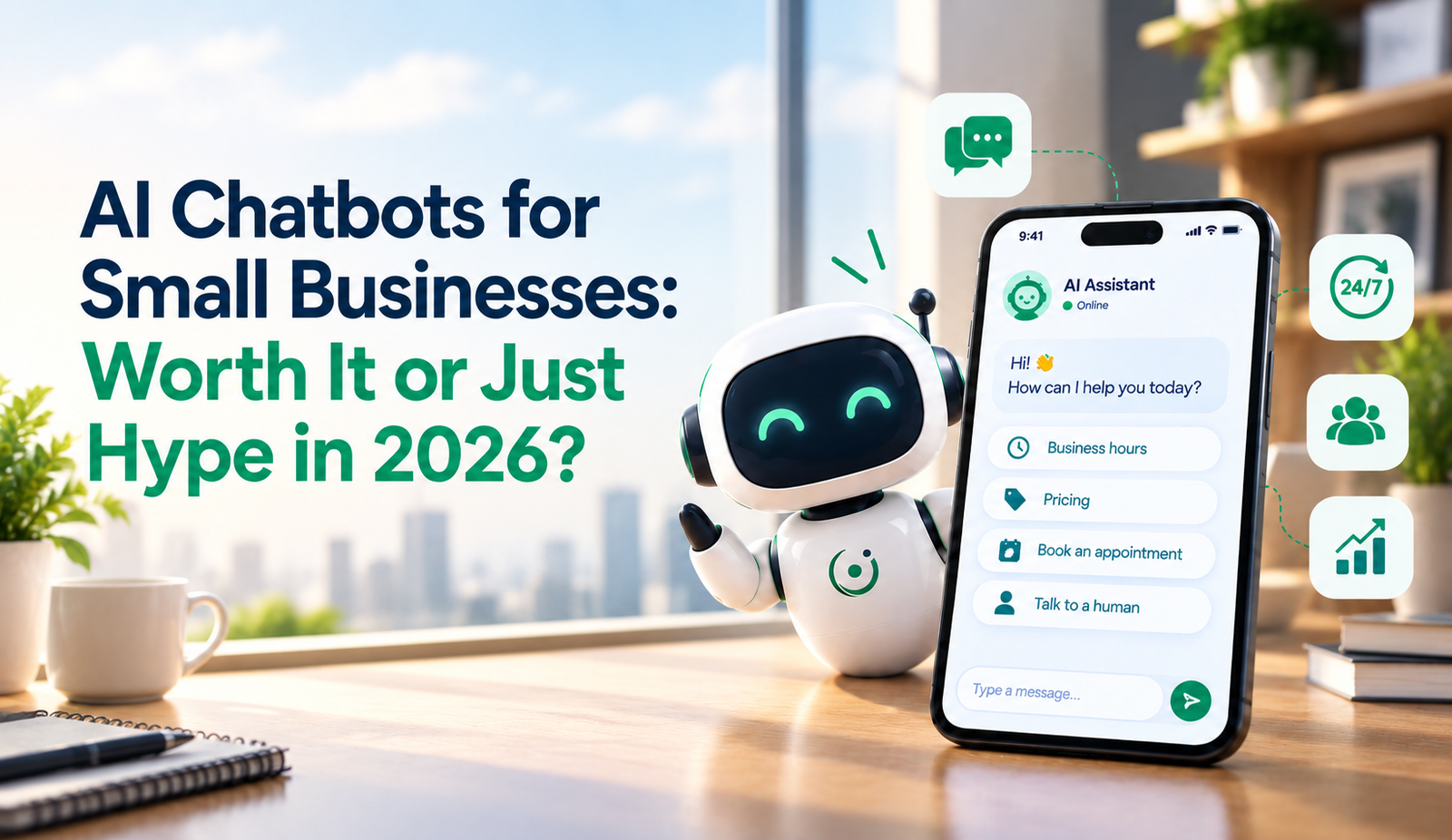
Every second ad you scroll past these days seems to be selling an AI chatbot that promises to “never miss a lead” or “run your customer service on autopilot.” If you run a small business, you’ve probably wondered whether this conversational AI trend is genuinely useful, or just another shiny virtual assistant tool that ends up gathering digital dust after week two.
We’ve had this exact conversation with more than one client who bought into the hype, installed a bot overnight, and then wondered why leads still slipped through the cracks. The honest answer is: it depends entirely on how you use it. AI chatbots have matured a lot since the clunky, scripted bots of a few years ago. But that doesn’t mean every business needs one, or that installing one will automatically fix your response times and lead flow. Let’s break down what these customer service automation tools actually do well, where they fall short, and how to decide if 2026 is the right time for your business to adopt one.
What AI Chatbots Actually Do in 2026
Modern AI chatbots are built on large language models rather than rigid decision trees. That means they can hold a more natural conversation, understand context across multiple messages, and handle a wider range of customer questions without needing every possible phrasing pre-programmed in.
For small businesses, this usually shows up in three practical ways:
- Answering repetitive questions business hours, pricing ranges, service areas, appointment availability instantly, at any hour, through automated customer support.
- Qualifying leads before a human ever gets involved, by asking a few structured questions and passing on only the serious inquiries.
- Capturing after-hours enquiries that would otherwise go to a competitor who happened to respond first.
None of this replaces a real conversation when a customer has a complex or emotionally sensitive issue. Good AI-powered customer engagement knows when to hand off to a person instead of trying to fake its way through it.
Where the Hype Outpaces Reality
A lot of chatbot marketing implies that once it’s installed, your customer service problems are solved. In practice, a few things trip businesses up:
Poor setup leads to poor answers. A chatbot is only as good as the knowledge base it’s trained on. If your business details, FAQs, and policies aren’t kept current, the bot will confidently give outdated or wrong answers, which damages trust faster than a slow human response would. We’ve seen this firsthand with businesses that launched a bot and never revisited its training data for months.
Over-automation frustrates customers. Nobody wants to be stuck in a loop with a bot when they clearly need a person. Businesses that don’t build in an easy escape hatch to live chat or a human agent often see complaints rise instead of fall.
It’s not free labour. Even the simplest chatbot tools need occasional review, retraining, and monitoring. Businesses that set it up once and never touch it again usually see performance quietly degrade over time.
When a Chatbot Genuinely Makes Sense
A chatbot tends to pay off when a business meets a few conditions:
- You get a steady stream of repetitive, predictable questions (pricing, timings, availability).
- You lose leads specifically because you can’t respond fast enough, especially outside working hours.
- You have someone even part-time who can check in on conversations and update the bot’s knowledge base regularly.
- Your website or WhatsApp business messaging already gets enough traffic that missed messages are a real, measurable cost.
If your enquiries are low in volume but high in complexity, say, custom project quotes or advisory services — a chatbot may add friction rather than remove it. In that case, a well-placed contact form or a fast human response process might serve you better.
Getting Started Without Overcomplicating It
You don’t need an enterprise-grade AI system to test the waters. Many small businesses start with a simple, well-configured conversational bot on WhatsApp or their website that handles FAQs and lead capture, then expand from there based on what customers actually ask. Starting small also makes it far easier to spot gaps and fix them before scaling toward more advanced virtual assistant capabilities.
Gartner forecasts that 40% of enterprise applications will be integrated with task-specific AI agents by the end of 2026, up from less than 5% today a pace of adoption that signals this shift isn’t a passing trend businesses can afford to ignore entirely, even if they choose to adopt it gradually. You can read more on Gartner’s full prediction.
In our own work rolling out chatbot and automation strategy for clients across India and the UAE, the businesses that see real returns are rarely the ones chasing the most advanced AI feature set. They’re the ones who match the tool to an actual, recurring bottleneck in their customer response process. If you’re evaluating tools and strategy for how AI fits into your customer experience without losing the personal touch that small businesses are known for, working with a team that understands both the technology and your local market makes the process a lot less overwhelming, something Medowa Global’s digital marketing services are built around.
Frequently Asked Questions
Do AI chatbots work for small budgets?
Yes. Many chatbot platforms now offer affordable tiers built specifically for small businesses, often starting with basic FAQ and lead-capture functions before scaling to more advanced automated customer support features.
Will a chatbot replace my customer service team?
No. It’s best used to handle repetitive, low-complexity questions and free up your team’s time for conversations that genuinely need a human touch.
How do I know if my business is ready for one?
If you regularly miss enquiries after hours or find your team answering the same handful of questions daily, that’s usually a good sign a chatbot could help.
Does a chatbot hurt my SEO or website experience?
Not if implemented well. A chatbot that loads efficiently and doesn’t interrupt the user experience can actually improve engagement by keeping visitors on your site longer.
Final Thought
AI chatbots aren’t hype, and they aren’t magic either. They’re a tool that works well for a specific set of problems, repetitive questions, slow response times, after-hours gaps and poorly for everything else. The businesses getting real value out of them in 2026 are the ones who set clear boundaries for what the bot handles, keep its knowledge base updated, and always leave the door open for a real person to step in when it matters.