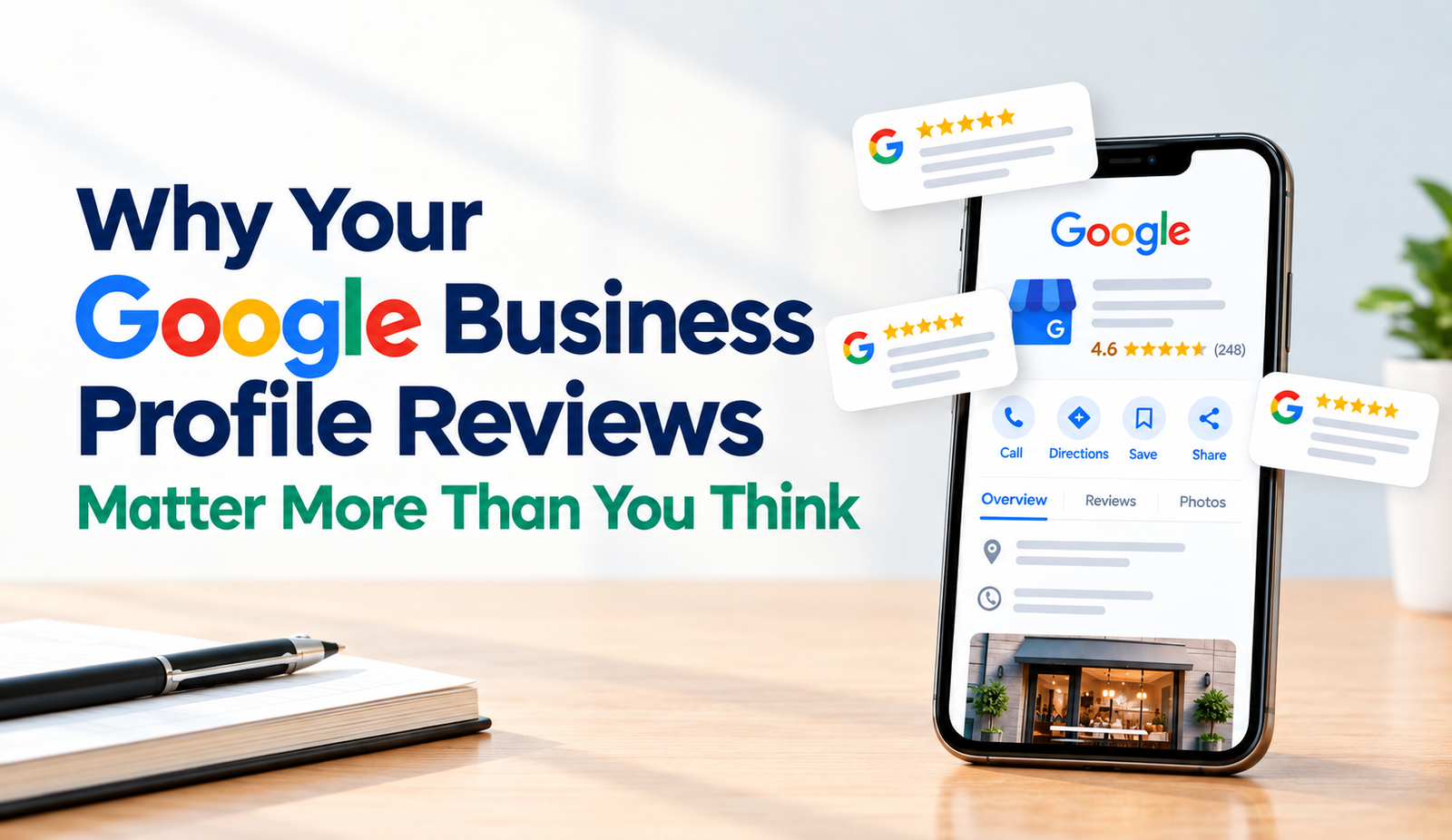
Most business owners check their Google Business Profile reviews the way people check a scoreboard, glance at the star rating, feel briefly relieved or mildly annoyed, and move on. If that’s where the attention stops, a genuinely powerful piece of the local search puzzle is being left on the table.
Reviews aren’t just social proof sitting passively on a listing. They actively shape how Google evaluates a business, and they influence customer decisions in ways that go far beyond the star count.
Reviews Are a Ranking Signal, Not Just a Trust Badge
Google has been fairly open about the fact that review count, review recency, and review score all factor into local pack rankings. A business with steady, recent reviews signals ongoing activity and relevance, while a profile with a handful of old reviews and nothing new in months can quietly slip in visibility, even if nothing else about the listing has changed.
What often gets missed is that the content inside reviews matters too. When customers naturally mention specific services, neighborhoods, or products in their reviews, it reinforces relevance signals that align with how people actually search. A review mentioning “same-day AC repair in the neighborhood” does more for local relevance than a generic five-star rating ever could.
The Response Matters as Much as the Review Itself
Here’s the part that surprises a lot of business owners: replying to reviews isn’t just good customer service, it’s an active signal too. According to Google’s own Business Profile guidance, businesses should keep replies genuine, specific, and conversational rather than promotional, since generic thank-you messages don’t add much value for future customers reading them later.
A thoughtful reply does two things at once. It shows the original reviewer their feedback was actually read, and it gives every future visitor evidence that the business is attentive and responsive, often the deciding factor when someone is choosing between two similarly rated options nearby.
Negative reviews deserve even more care here. A calm, specific, non-defensive response to a critical review frequently reassures potential customers more than a wall of five-star ratings does, because it shows how a business behaves when things don’t go perfectly.
Review Velocity Says More Than Review Volume
A profile with 200 reviews collected three years ago tells a different story than one with 40 reviews spread evenly across the last six months. Google and customers both tend to weigh recency heavily. Review velocity, meaning how consistently new reviews come in over time, often matters more for local visibility than the raw total ever will.
This is exactly why businesses that build review collection into their regular customer follow-up process, rather than treating it as an occasional afterthought, tend to see steadier local search performance over time.
Reviews Influence Click-Through Behavior Directly
Even when two businesses rank next to each other in the local pack, the one with more recent, more detailed reviews usually wins the click. People scan star ratings quickly, but they also skim the actual text for anything relevant to their specific need, whether that’s pricing transparency, response speed, or how a particular issue got resolved.
This is where the connection between reviews and broader SEO becomes clearer. A well-optimized Business Profile with strong on-page SEO on the website behind it creates a compounding effect, more people notice the listing, more of them read the reviews closely, and more of them convert into inquiries.
What Actually Moves the Needle
A few practices consistently separate businesses with strong review profiles from the ones struggling to gain traction:
Asking for reviews at the right moment, right after a positive interaction or completed service, rather than in a generic monthly email blast that gets ignored
Making it effortless, since a direct link or QR code removes almost all the friction that stops satisfied customers from following through
Responding within a reasonable window, ideally a few days, since delayed responses lose most of their impact on anyone reading them later
Never incentivizing reviews with discounts or freebies, which violates Google’s policies and puts the entire profile at risk of penalty or removal
Treating negative reviews as material for a thoughtful public response, not something to argue with or ignore
None of this requires a large budget or specialized software. It requires consistency, the same quality that tends to separate businesses that grow steadily in local search from the ones that plateau.
Why This Gets Overlooked So Often
Reviews sit in a strange spot for a lot of businesses. They feel like a customer service task rather than a marketing one, so they end up owned by whoever happens to check the notifications, if anyone does at all. Meanwhile, the SEO strategy, the website audits, the keyword tracking, all get treated as the “real” work.
In reality, review management deserves a seat at the same table as those efforts, because it’s directly feeding the local ranking algorithm and shaping first impressions before a potential customer ever visits the website.
Businesses that start treating their Business Profile reviews as an active, ongoing part of their SEO strategy, not a passive reputation tracker, tend to notice the difference in both visibility and inbound calls within a few months.
If review management feels like one more thing sitting on an already full plate, that’s usually a sign it’s time to bring in a partner who can build it into a broader, consistent local SEO strategy. Medowa Global’s search engine optimization approach folds review management directly into the local ranking work, so it stops being an afterthought and starts contributing to actual growth.
Frequently Asked Questions
How many Google reviews does a business need to rank well locally?
There’s no fixed number. What matters more is consistency, a steady flow of recent, genuine reviews tends to outperform a large but stagnant review count.
Does replying to every review actually make a difference?
Yes, particularly for negative reviews. A thoughtful, specific response signals attentiveness to both the reviewer and anyone reading the profile later.
Can offering a discount for a review get a business penalized?
Yes. Google’s policies explicitly prohibit incentivizing reviews, and violations can result in review removal or profile restrictions.
How quickly should a business respond to a new review?
Within a few days is ideal. Responses that come weeks later lose much of their impact on future readers evaluating the business.