Open any marketing newsletter this year and you’ll find another “game-changing AI tool” sitting right in the subject line. Most weeks, it’s the same automation wearing a slightly new interface. A handful of these tools genuinely change how a marketing team works day to day. The rest just add one more login nobody remembers the password for.
We work with clients across very different budgets and team sizes, and the question we hear most often isn’t “what’s the best AI tool out there.” It’s “which one actually fits what I’m stuck on right now.” That’s a far more useful question to ask, so this guide answers it by use case instead of handing you one long ranked list. Find the bottleneck that sounds familiar below and start there.
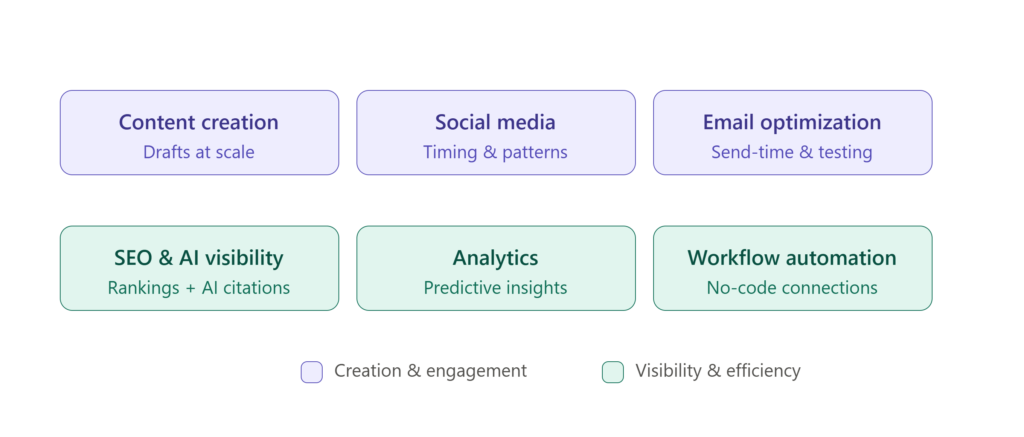
Content Creation and AI Writing Tools
Producing content at scale used to mean hiring more writers or stretching the ones you already had a little thinner. AI writing tools changed that math, though the change comes with real limits that are worth understanding before you lean on them too heavily.
The better platforms in this space go beyond basic grammar checking. They learn brand voice guidelines, tone preferences, and even audience psychographics, which means the drafts they produce sound noticeably closer to a specific brand than generic AI text usually does. Blog outlines, ad copy variations, and email sequences that once took a good chunk of a workday can now get a usable first pass in minutes.
The honest limitation, though, is originality. Generative AI writing tools are excellent at clearing the blank page and not so great at replacing genuine expertise or lived experience. Content that ranks well and actually earns trust still needs a human layer somewhere, real examples, real data, and a point of view the tool simply didn’t generate on its own. Teams that treat these tools as a first-draft engine rather than a finished product tend to come out ahead.
SEO and AI Search Visibility Tools
SEO tools have quietly turned into something broader: AI visibility tools. Ranking on Google’s results page still matters, obviously, but it’s no longer the entire game anymore. Marketers now also need to know whether ChatGPT, Gemini, and Perplexity mention their brand when someone asks a related question inside those platforms instead.
Modern SEO platforms have adapted fast. Keyword research, competitor analysis, and on-page optimization now sit right alongside dashboards tracking AI citation frequency, essentially measuring how often a brand gets referenced inside generative search answers rather than just how far up it sits on a traditional results page. For any business trying to stay discoverable as search behavior keeps drifting toward AI-generated summaries, this category has gone from optional to something closer to foundational.
Social Media Management Tools
AI has pushed social media tools well past basic scheduling at this point. Current platforms can analyze actual audience behavior to suggest better posting windows, generate several caption variations for testing, and flag underperforming posts early enough that a team can still do something about it.
Honestly, the real value here isn’t the content generation piece. It’s pattern recognition at a scale no single social media manager could realistically track by hand across several accounts, platforms, and time zones at once. That kind of always-on monitoring is where the automation earns its keep.
Analytics and Predictive Marketing Tools
This is arguably where AI delivers the most measurable return. Predictive analytics tools process historical campaign data, sometimes tens of thousands of marketing events a month, to forecast performance, recommend budget shifts, and surface which channels are actually driving revenue rather than just clicks.
McKinsey’s research on generative AI in marketing points to marketing and sales as one of the functions capturing the largest share of value from AI adoption, driven mainly by personalization and process automation. That lines up with what we tend to see in practice too. Every marketing budget eventually needs an answer to “where does the next rupee actually go,” and that’s precisely the question these tools are built to help answer with data instead of a gut feeling.
Email Marketing Optimization Tools
Email hasn’t gone anywhere, and AI has made it noticeably sharper over the past year or so. Send-time optimization tools now learn when individual subscribers genuinely open their inbox, instead of applying one blanket send time across an entire list regardless of who’s on it. Subject line testing, list segmentation, and re-engagement sequences can now run largely on autopilot once the initial setup is done right.
The catch mirrors content tools almost exactly: automation without a clear underlying strategy just automates a mediocre email program a little faster. The tool amplifies whatever strategy is already there, for better or for worse.
Workflow Automation Tools
This is probably the fastest-growing category right now, and it’s not hard to see why. AI-powered automation platforms let marketers connect different tools, apps, and data sources without writing a single line of code, effectively letting someone build a custom internal workflow in an afternoon that would have needed a developer just a couple of years back.
For small and mid-sized marketing teams especially, this category often delivers the biggest time savings of all, mainly because it removes the repetitive manual work of shuffling data between tools that were never really designed to talk to each other in the first place.
How to Actually Choose the Right Tools
With this many categories competing for attention, the temptation is to adopt several at once. In our experience, that rarely works out the way people hope.
- Identify your single biggest time sink first, not the most exciting new feature on the market
- Start with one tool in that category and use it properly for a full month before layering on another
- Check how each platform handles your customer data before adopting it, not after the fact
- Revisit your stack every few months, since this space moves fast enough that last year’s best pick isn’t always this year’s right one
AI tools aren’t a replacement for marketing strategy. They’re a way to execute an existing strategy faster, with fewer manual bottlenecks slowing everything down. Marketers who treat AI that way tend to see real, measurable results. Marketers who expect the tool to think strategically on their behalf usually end up disappointed sooner or later.
Getting the strategy right first, and choosing tools that support that strategy rather than define it, is where most of the actual value in AI marketing comes from. That’s worth more of your attention than any tool comparison chart, this one included.
Frequently Asked Questions
Are AI marketing tools worth it for small businesses?
Yes, for specific bottlenecks. A small business doesn’t need ten tools running at once. One well-chosen platform addressing a genuine time sink, like content drafting or email send-time optimization, usually delivers more value than a full stack adopted all at once.
Do AI marketing tools replace the need for a marketing team?
No. They cut down on repetitive manual work, but strategy, brand judgment, and interpreting what the data actually means still need human decision-making and real experience behind them.
How do I know if an AI tool actually works for my brand?
Run it for a defined trial period against one specific metric, not just a general impression. If it doesn’t move that metric within a month or two, it’s probably not the right fit yet.
What’s the biggest mistake marketers make with AI tools?
Adopting too many at once without a clear priority. It leads to scattered data, inconsistent output across channels, and no clean way to actually measure what’s working.
Choosing the right tools is only half the equation. If you’d like help building a marketing strategy that actually puts them to use, Medowa Global can help you figure out where to start.