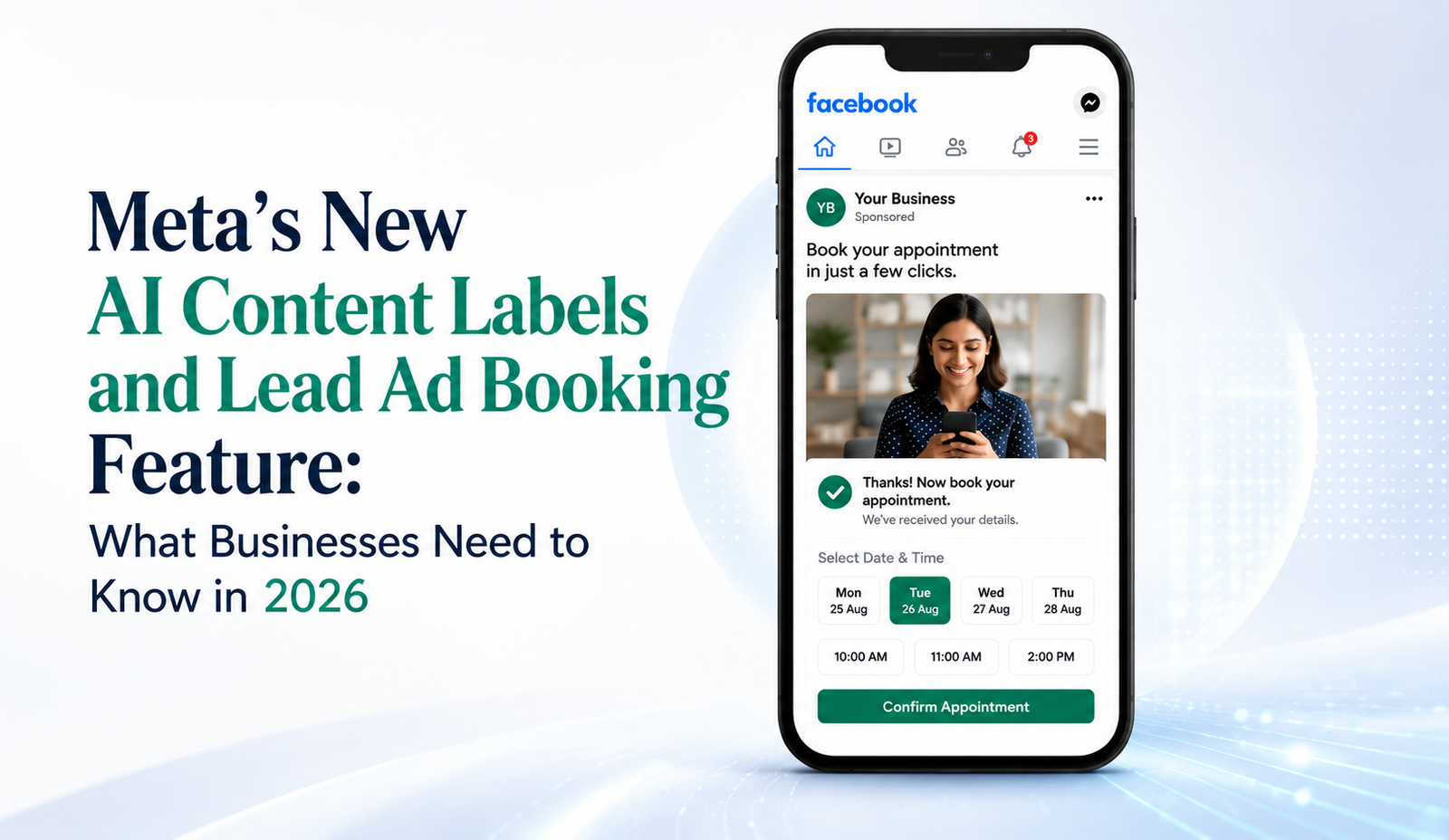
Meta is changing two things at once in 2026, and both affect how businesses show up on Instagram and Facebook. The first is a bigger push toward AI content transparency, with provenance labels appearing on more posts and ads than before. The second is a new integrated booking feature for lead generation ads, built to turn form submissions into confirmed appointments without the prospect ever leaving the platform.
Neither update is cosmetic. One changes how AI-assisted creative gets flagged and reviewed. The other changes how leads actually move through the funnel. Here’s what’s happening, and what it means for anyone running ads or building an organic presence on Meta’s platforms right now.v
Why Meta Is Adding AI Provenance Labels
The push for AI transparency isn’t coming from Meta alone. Regulators, platforms, and audiences have all been pressing for clearer disclosure as generative tools quietly become part of everyday content production. The EU AI Act’s Article 50, in force since August 2026, requires AI providers to mark synthetic content in a machine-readable way and requires deployers to disclose deepfakes. That kind of regulatory pressure has pushed platforms like Meta to formalize their own labeling systems well beyond that one rule.
Meta’s detection runs on a mix of provenance signals, most notably the IPTC Digital Source Type embedded in a file’s metadata and C2PA (Coalition for Content Provenance and Authenticity) manifests. When Meta’s systems read that metadata on an upload, whether it’s an organic post or a paid ad, an “AI Info” label gets applied automatically. Where metadata isn’t present, self-disclosure and Meta’s own classifiers fill the gap.
Where the Labels Show Up
On organic content, the label typically appears under the username or within the post’s info menu. On ads, it can show inside the “About this Ad” panel, or as a more visible on-image label when the content includes something like a photorealistic AI presenter. Placement depends on how synthetic the content is judged to be. Light AI-assisted edits, things like color correction or minor cleanup, generally don’t trigger a label at all.
The Part Advertisers Often Miss
Here’s the detail that catches a lot of marketers off guard: there isn’t one universal provenance standard. IPTC and C2PA overlap but don’t fully interoperate, and different Meta surfaces read them differently. That means the same image can be labeled on one placement and unlabeled on another, and metadata is frequently stripped when files are resized or transcoded during upload.
Self-disclosure through Ads Manager’s disclosure control remains the only reliable way to stay consistent across every placement, rather than depending on automatic detection to catch everything. Meta’s own Help Center page on AI-generated ad labeling confirms this directly, it notes the labeling rollout is still gradual, and not every ad using Meta’s generative AI features carries an AI Info tag yet, even when it should. If avoiding an inconsistent or missing label matters to a brand, that’s reason enough to disclose manually rather than wait and hope the system catches it.
The New Integrated Booking Feature for Lead Generation Ads
The second update is aimed squarely at service-based businesses. Meta has introduced embedded appointment booking for lead ads, connecting third-party scheduling platforms directly to the Instant Form experience. Once someone submits their details, a booking widget appears on the thank-you screen, showing available time slots so they can confirm an appointment in the same session. Their name, email, and phone number carry over automatically, so there’s no re-entering information at the booking stage.
The feature currently supports Calendly and HighLevel, with HubSpot integration expected to follow. Advertisers can also add qualifying questions within the Instant Form before a lead reaches the booking step, which helps filter out unqualified enquiries before they ever hit a calendar.
Facebook First, Instagram Still Catching Up
It’s worth being precise here, because a lot of coverage blurs this detail: the fully embedded booking experience is rolling out on Facebook first, in phases, with global availability expected by October. On Instagram, native embedding isn’t supported yet. Users instead see a “Book Time” button that opens the scheduling page in an in-app browser. It still gets people to a calendar, but it isn’t the same frictionless, in-feed experience Facebook is getting. Businesses running lead campaigns across both platforms should plan for that gap rather than assume identical performance on each.
According to Social Media Today’s coverage of the rollout, the update is designed to close exactly this gap between someone expressing interest and taking the next step, a challenge that has historically cost service-based advertisers a meaningful share of warm leads before they ever convert.
Who Gets the Most Value
This update was clearly built with service-based advertisers in mind: healthcare providers, home services, consultants, real estate agents, and local businesses that live or die by how fast a lead converts into a booked slot. The gap between someone filling out a form and actually scheduling time has always been where warm leads go cold. Closing that gap inside the ad experience itself, rather than through a follow-up call or email that may never get opened, is a meaningful shift for anyone whose business depends on appointments rather than direct purchases.
What This Means for Businesses in India and the UAE
For businesses running Meta ads out of Kerala or the wider UAE market, both updates are worth acting on now rather than waiting for full rollout.
On the labeling side, it’s worth auditing current ad creative for AI involvement, even minor AI-assisted edits, and manually flagging it through Ads Manager’s disclosure control instead of relying on automatic detection. Given how inconsistently metadata survives upload and transcoding, self-disclosure is the safer path.
On the booking side, service businesses running Facebook lead ads should check whether their current booking platform is on Meta’s supported list, and start testing the feature as access expands. For Instagram campaigns, it still makes sense to keep a strong thank-you screen with a clear next step, since the native in-feed booking experience isn’t there yet.
Frequently Asked Questions
Does Meta label all AI-generated content the same way?
No. Labeling depends on how synthetic or photorealistic the content is judged to be. Minor AI-assisted edits usually don’t get labeled, while fully AI-generated visuals, manipulated realistic media, and synthetic voice or music typically do.
Is the integrated booking feature available on Instagram yet?
Not in the same embedded form as Facebook. Instagram currently shows a “Book Time” button that opens the scheduling page in an in-app browser rather than embedding the calendar directly in the ad experience.
Which booking platforms work with Meta’s lead ads right now?
Calendly and HighLevel are supported at launch, with HubSpot integration expected to follow as the rollout continues.
Should businesses self-disclose AI content even if Meta doesn’t detect it automatically?
It’s the more reliable approach. Because provenance metadata isn’t always preserved across every platform and file type, manual disclosure through Ads Manager avoids the inconsistency that comes with relying on automatic detection alone.
Both of these updates point in the same direction: Meta is tightening transparency around AI while also trying to make the ad-to-conversion journey shorter. Businesses that get ahead of the disclosure requirements and test the new booking flow early will likely see smoother campaign performance as both features reach full availability. For teams that want a second set of eyes on how their current ad setup holds up against these changes, this is exactly the kind of platform shift Medowa Global tracks closely for clients running paid campaigns across India and the UAE.