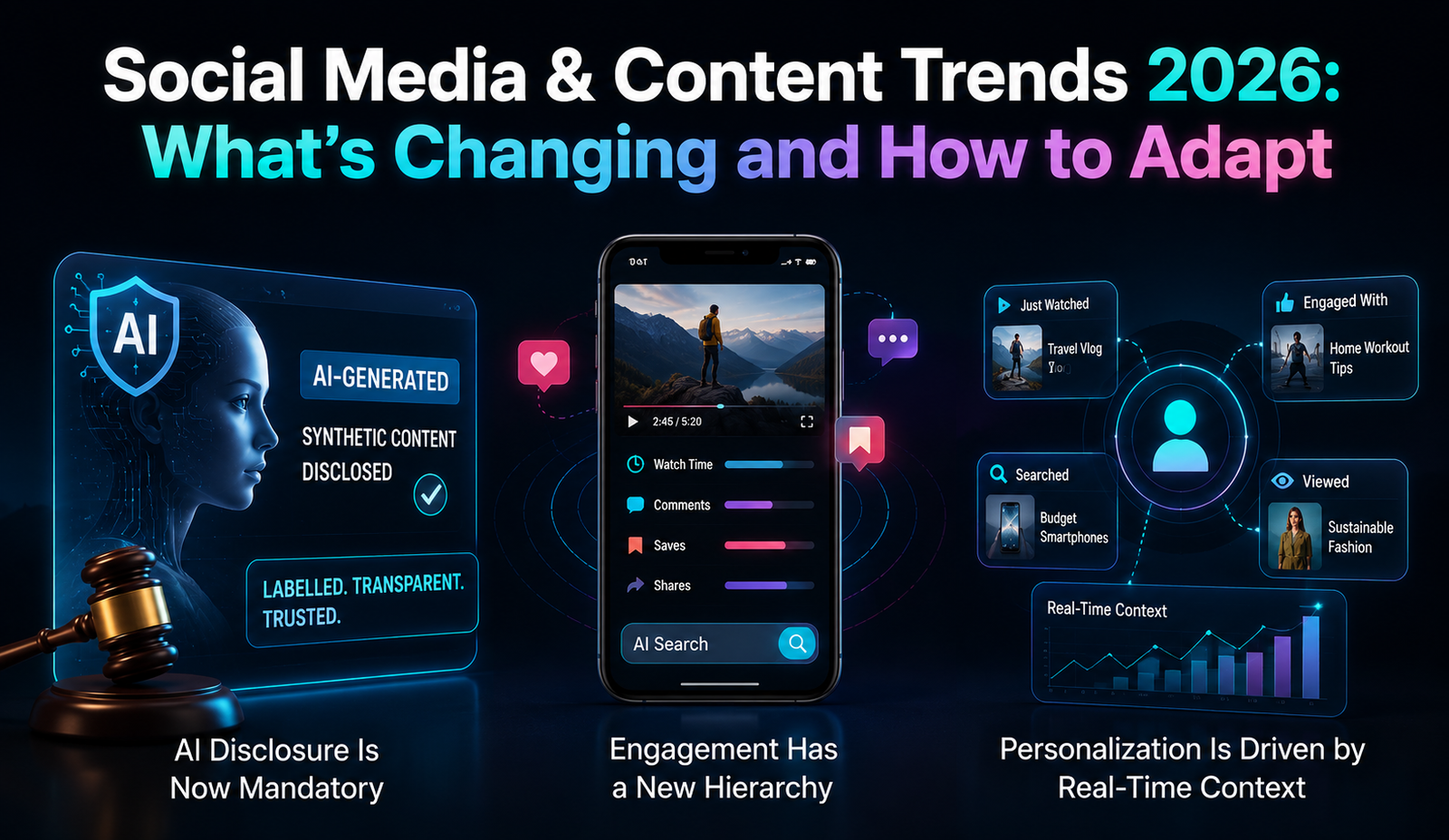
Social platforms are moving on three fronts at once this year regulation around AI-generated content, a redefined sense of what “engagement” means, and a shift toward real-time, context-based personalization. None of these are minor tweaks. Together they change what gets rewarded, what gets flagged, and what actually reaches an audience. Here’s a closer, more complete look at each shift, why it’s happening, and what it means in practice.
AI Disclosure Is Now a Regulatory Requirement, Not a Best Practice
India’s Ministry of Electronics and Information Technology (MeitY) notified the Information Technology (Intermediary Guidelines and Digital Media Ethics Code) Amendment Rules, 2026 in February, formally defining “synthetically generated information” and requiring it to be labelled and embedded with identifying metadata. Platforms have started enforcing this structurally rather than leaving disclosure to creator discretion TikTok, for instance, now restricts fake AI-generated voices in shopping livestreams outright.
What This Means in Practice
- AI voiceovers and avatars: Any asset using a synthetic voice, face, or fully AI-generated performance needs a clear label. Presenting it as authentic without one is a compliance gap, not a stylistic choice.
- AI-assisted vs. AI-generated: The line matters. Using AI to edit, format, or research content isn’t the same as generating a synthetic voice or likeness; only the latter typically triggers labelling obligations. The MeitY FAQ document on the amendment rules is a useful reference for where that line currently sits.
- Livestream and shopping content: This is the category seeing the most direct platform-level enforcement right now, since synthetic voices in a live sales context carry the highest risk of misleading viewers.
Treat this labelling requirement as a trust signal for the audience, not just a legal checkbox being upfront about AI use tends to build more credibility than it costs.
The Engagement Hierarchy Has Been Redefined
Follower counts and raw likes carry less algorithmic weight than they used to. Platforms are now prioritizing longer video watch time, comment-driven discussion, saves, and shares signals that are harder to inflate and correlate more closely with genuine interest. Meta has also built AI-powered search directly into its platforms, which means content now has to perform as a search result within the app, not only as a feed post.
What This Means in Practice
- Format mix: Content calendars dominated by short, low-substance clips optimized purely for reach likely need rebalancing toward longer video that can sustain watch time and prompt discussion.
- Caption and on-screen text: These now do double duty as discovery content worth writing so they can answer the kind of query a user might type into in-app AI search, not just for scannability in the feed.
- Comment prompts: Posts structured to invite genuine discussion (a direct question, an open-ended prompt) tend to outperform ones that assume engagement will happen passively.
- Save-worthy value: Content framed as a reference, a checklist, a how-to, a comparison tends to earn more saves than purely entertainment-first formats, and saves are now a stronger ranking signal than likes.
Personalization Is Shifting from Demographics to Real-Time Context
Static demographic segments age band, location, broad interest category are becoming a weaker proxy for who actually responds to a piece of content. The more reliable signal now is what a user is doing in the moment: what they just watched, searched, or engaged with.
What This Means in Practice
- Creative variation: A single static asset aimed at one demographic segment is harder to match to real-time context. Building 2–3 creative variants per campaign, aimed at different intent signals rather than different age groups, tends to perform better under current targeting models.
- Data hygiene: Contextual targeting is only as accurate as the data feeding it. Clean, consented, real-time data flows matter more than a large historical demographic dataset now.
- Attribution windows: Reporting that still leans on last-click, demographic-bucketed attribution may be underselling content that’s actually winning on context-based engagement.
- Timing sensitivity: Because context-based targeting reacts to what a user is doing right now, campaigns that can adjust creative or messaging quickly tend to capture more of this real-time relevance than ones locked into a fixed rotation.
FAQ
Does the 2026 labelling requirement apply to all AI-assisted content? No. It’s aimed specifically at synthetically generated information content where a voice, face, or performance is fabricated and presented as real. Routine AI-assisted editing or formatting generally falls outside that definition, though the line is still being clarified in practice.
Why are saves and shares weighted more heavily than likes now? They’re harder to inflate artificially and more strongly indicate that content actually delivered value to the viewer, which is closer to what platforms are trying to optimize for.
What changed with Meta’s AI search integration? Content now needs to work as an answer to an in-app search query, not just as a feed post which puts more weight on clear captions and on-screen text than before.
How is contextual personalization different from traditional targeting? Traditional targeting segments audiences by fixed traits like age or location. Contextual personalization reacts to what a user is doing in real time, what they just watched, searched, or engaged with — and adjusts messaging or creativity accordingly.
How These Three Shifts Connect
These aren’t three unrelated changes; they reinforce each other. Transparent AI disclosure builds the kind of trust that makes an audience more willing to engage meaningfully (rather than scroll past), which feeds directly into the watch-time, save, and share signals platforms now reward. And genuine engagement, in turn, generates exactly the kind of real-time behavioral data that makes contextual personalization work well. Treating these as one connected shift, rather than three separate to-do items, makes it easier to prioritize where to act first.
For most content teams, that means starting with disclosure since it carries the clearest regulatory and platform-enforcement risk then moving on to reworking format mix and captions for the new engagement signals, and finally revisiting targeting once the content and data feeding it are already in better shape. Trying to fix all three at once tends to spread effort too thin; sequencing them this way lets each step build on the one before it.
We track shifts like these closely as part of our ongoing content and strategy work at Medowa Global happy to walk through what they mean for your own social presence.