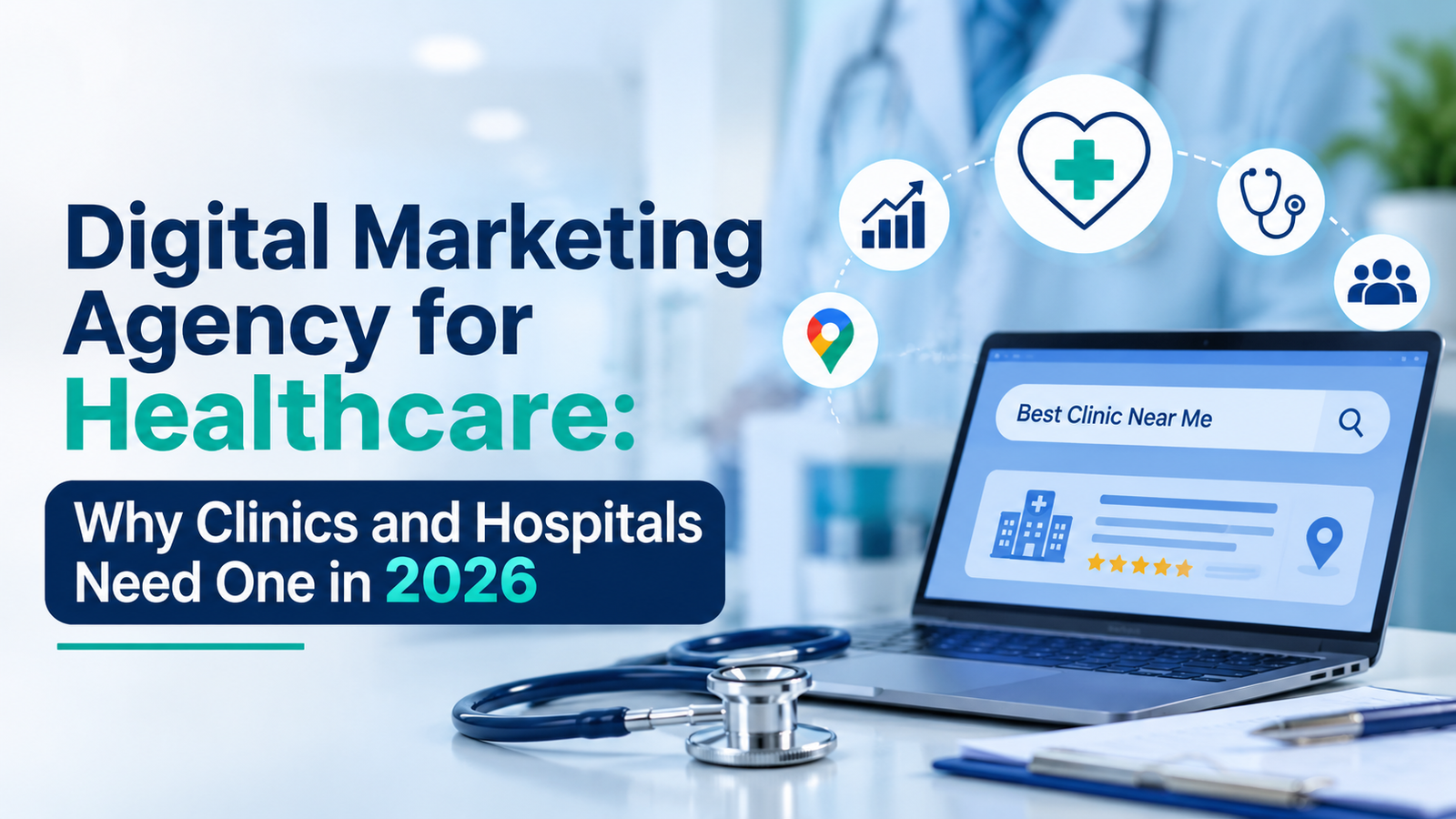
A digital marketing agency for healthcare is worth hiring because patients now research clinics online before they call, Google applies stricter trust checks to health content, and the National Medical Commission (NMC) issued new advertising guidelines in October 2026. A specialist agency helps you stay visible and compliant at the same time. A generic one can quietly put your reputation, and even your registration, at risk.
A clinic owner’s first instinct is often to hand marketing to a staff member who is “good with social media.” It’s a reasonable instinct. It’s also where trouble starts, because healthcare marketing carries rules most other industries never face.
Why can’t a clinic just post online and hope for appointments?
Patients rarely begin with your reception desk. They begin with a search.
- They type a symptom or treatment into Google.
- They open Maps and compare nearby clinics.
- They read reviews and look at doctor credentials.
- They check whether your website explains things clearly.
- They call or message only after all of that.
If you are hard to find or unclear at any one step, the patient simply moves on. You never see it happen.
An agency’s first job is to connect these steps, so the path from search to appointment doesn’t leak.
What changed for healthcare advertising in India in October 2026?
The NMC issued guidelines on ethical advertising and public communication for hospitals, medical institutions and registered medical practitioners. As reported by ETV Bharat, the framework covers websites, social media, messaging platforms, search engines, influencer content and AI-generated promotions.
The main points, as reported:
- Claims such as “best doctor,” “No. 1 specialist,” “100% success” or “miracle treatment” are barred.
- Comparative claims like “leading” or “most trusted” need an objectively verifiable method behind them.
- Patient testimonials and before-and-after representations are restricted, and patient consent alone doesn’t make them acceptable.
- Discounts, limited-period offers, contests, cashback and free procedures are restricted where they could encourage unnecessary consultations or treatment.
- Paid or manipulated reviews, ratings, followers, likes and search rankings are barred.
- AI-generated promotional campaigns aimed at commercial interests are prohibited, and permitted AI content needs a clear disclosure.
- Hospitals may still publish factual details such as departments, facilities, equipment, emergency services, accreditation and charges.
- Penalties are graded, from a warning to suspension and, for repeated violations, removal from the medical register for a period.
This is a summary from news coverage. Read the full guideline, or speak to a legal adviser, before publishing anything.
It also explains why generic advice like “run an offer and chase followers” can backfire badly for a clinic.
What does a healthcare digital marketing agency actually handle?
Most of the work happens quietly in the background. Here is how it breaks down.
| Area | What the agency handles | Why healthcare needs extra care |
|---|---|---|
| Website and SEO | Service pages, doctor profiles, mobile speed, search-friendly structure | Content must be accurate and free of exaggerated claims |
| Google Business Profile | Correct timings, services, photos, Q&A, review replies | Replies must never reveal patient details |
| Educational content | Articles and FAQs on conditions and treatments | Informational and evidence-based, not promotional |
| Paid ads | Search and social campaigns for services and appointments | Copy and offers must be checked against advertising rules |
| Tracking | Calls, WhatsApp clicks, form submissions | Health details should never flow into analytics |
| Reputation | A simple process for genuine patient feedback | No incentives, no manipulated ratings |
Why does Google treat health websites differently?
Because wrong health information can affect someone’s wellbeing. Google’s guidance on helpful, reliable, people-first content asks who created a page, how it was made and why. For health topics, those questions carry more weight.
An agency builds that trust into the site itself.
- Name the doctor or clinical team behind each page.
- Show real qualifications where appropriate.
- Add a clear “reviewed by” note to medical articles.
- Keep your address, phone number and timings identical everywhere.
- Secure the site and publish clear privacy information.
That last point is bigger than it sounds. Our guide to website trust signals, security and rankings explains how visible safety cues affect both visitors and search performance.
How do patients find you in local and AI search now?
Mostly through Maps and, increasingly, through AI answers.
For local search, your Google Business Profile does a lot of the heavy lifting. Reviews feed into how visible you are, and our piece on Google Business Profile reviews in 2026 covers why they matter. In healthcare, one caution applies. Genuine patient reviews help, but incentivising them or republishing them as promotion is where the new rules bite. Build a simple, honest process and confirm it with your adviser.
For AI search, patients now ask tools like ChatGPT and Google’s AI features which clinic suits a particular need. Clear factual pages about departments, facilities and timings give those systems something dependable to quote. Our AEO and GEO guide explains how this works.
The nice part is that factual institutional information is exactly what the NMC framework allows hospitals to publish.
How do you know marketing is really bringing appointments?
Traffic alone proves very little. What matters is whether people take the next step.
- Count phone call clicks.
- Count WhatsApp button clicks.
- Count appointment form submissions.
- Check calls and direction requests on your Google Business Profile.
Setting this up properly in analytics is covered in our Google Analytics guide. One rule is specific to healthcare: never send patient names or health conditions into analytics, and follow applicable data protection law.
A good monthly report shows enquiries and appointments first. Followers and impressions come after.
How do you choose the right agency for a healthcare brand?
Ask direct questions and listen carefully to the answers.
| Ask this | A good answer sounds like | A red flag sounds like |
|---|---|---|
| How do you handle medical advertising rules? | Claims review and a legal check before anything goes live | “Those rules don’t apply online” |
| Who reviews medical content? | A qualified clinician signs off | Anonymous writers, no review |
| How will you get us reviews? | Genuine feedback requests, no incentives | Bulk or paid reviews |
| What will you report? | Calls, forms, WhatsApp, appointments | Followers and impressions only |
| What will you promise on rankings? | Honest timelines, no guarantees | “Guaranteed #1 in 30 days” |
Final Thought
Healthcare marketing isn’t about shouting louder than the clinic down the road. It’s about being easy to find, clear to understand and careful with every claim. When rules are tightening, that care becomes part of the strategy.
If you are planning marketing for a clinic or hospital and want it built around visibility and compliance, a digital marketing agency in Kerala like Medowa Global can help you work out where to start.
Frequently Asked Questions
Do clinics and hospitals really need a digital marketing agency?
Not always, but search, local listings, content, tracking and advertising rules add up to a lot for a clinical team already busy with patients. An agency helps most when it genuinely understands healthcare rules.
Can a healthcare provider still run ads and offers in India?
Ads are possible within the rules. Under the NMC guidelines as reported in October 2026, discounts and promotional offers are restricted where they could encourage unnecessary consultations or treatment. Check with a legal adviser and the ad platform’s own health policies.
Can we show patient testimonials on our website?
Under the reported guideline, testimonials and before-and-after representations used for promotion are restricted, and patient consent alone doesn’t make them permissible. Confirm with a legal adviser before publishing.
How long does SEO take for a clinic website?
Usually several months, depending on competition, site condition and content quality. No honest agency can guarantee rankings.