
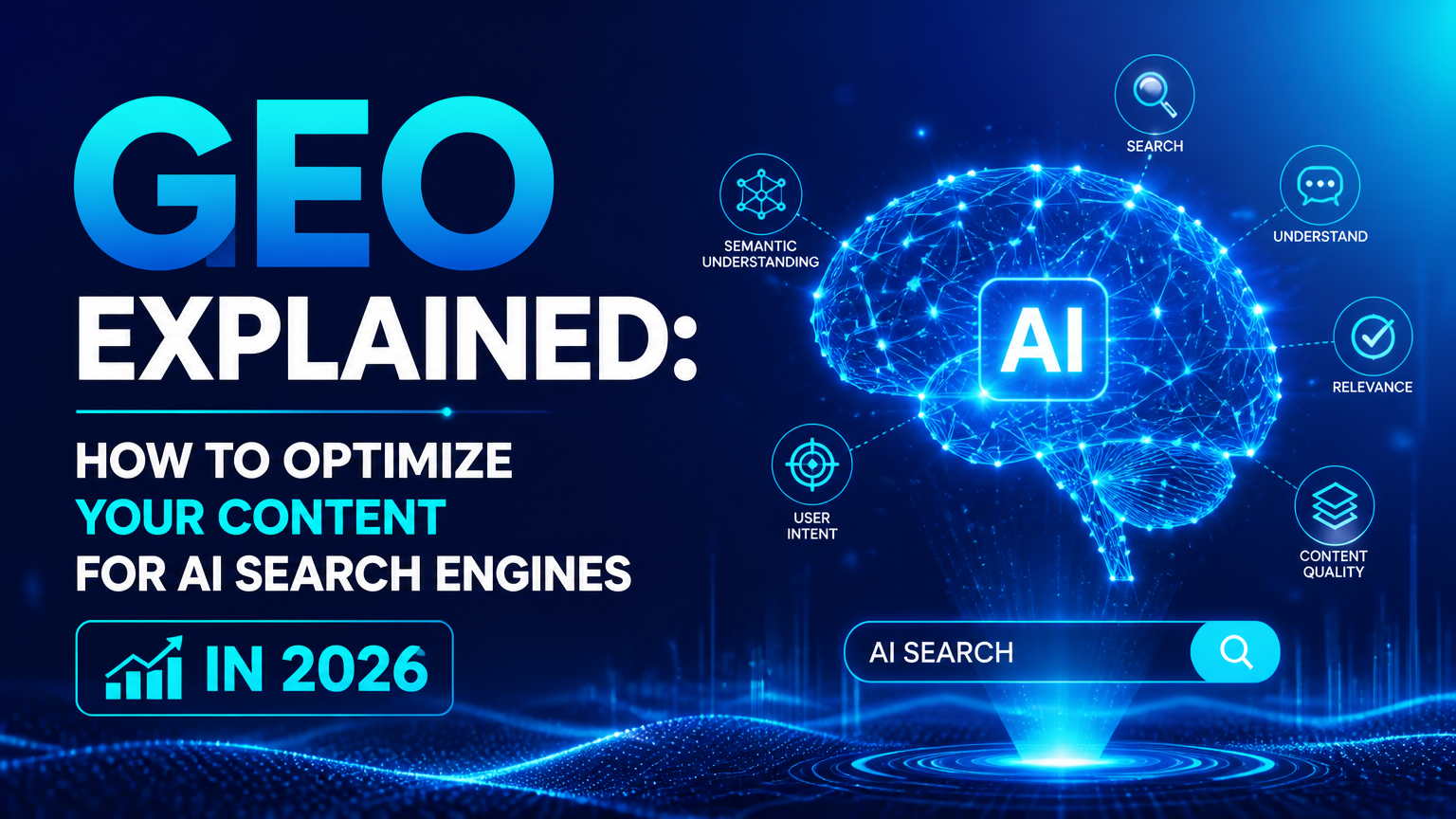
Type almost anything into Google now and there’s a decent chance you won’t scroll past the first answer. AI Overviews and AI Mode pull together a response from several sources before you’ve even clicked anything which means the old goal of “rank on page one” isn’t quite enough anymore. The newer question is whether an AI system trusts your page enough to actually quote it. That’s what people have started calling GEO, or Generative Engine Optimization.
It helps to think of GEO as a layer on top of SEO, not a replacement for it. Businesses that get left out of AI-generated answers usually aren’t doing anything wrong by traditional SEO standards they’re just not built for how these newer systems read a page.
So how is GEO actually different from SEO?
Traditional SEO is, at its core, about ranking climbing as high as possible on a page someone’s going to scroll through. GEO is chasing something a little different: getting picked as one of the handful of sources an AI system pulls from when it’s building a single answer.
That distinction matters more than it sounds. A page can sit comfortably at position two or three in normal search and still get skipped entirely by an AI Overview, because the two systems aren’t judging content the same way. AI answer engines seem to favor pages that are clearly structured, that answer a specific question directly, and that read as authoritative enough to be worth citing. Google’s own documentation on AI features backs this up there’s no separate technical checklist to unlock AI Overviews or AI Mode; a page just needs to be indexed and eligible to appear in Search with a snippet, which puts the focus right back on solid SEO fundamentals rather than any hidden AI-specific trick.
Write for extraction, not just for reading
Here’s the thing about how these systems work: they’re pulling out facts, definitions, and direct answers to stitch into a response. If your actual answer is buried three paragraphs into a wall of preamble, that’s a lot harder for a system to lift cleanly. Give the direct answer early, right after the question, and expand on it afterward. That order alone makes a real difference.
Headings do more work here than people give them credit for, too. An H2 or H3 phrased the way someone would actually ask the question, not just a keyword stuffed into a header acts almost like a label the AI system can grab onto.
E-E-A-T isn't optional here if anything, it matters more
These systems are being built to lean on sources that look genuinely trustworthy, because their own credibility rides on what they cite. So the usual E-E-A-T checklist real expertise, transparent sourcing, content that actually reads like it was written by someone who’s done the thing carries extra weight when an AI is deciding who to quote.
Structured data gives the AI a shortcut
Schema markup is basically a translation layer it tells a generative engine what kind of content it’s looking at and how the pieces relate, without the system having to guess. Pages with solid structured data tend to get parsed more accurately, and when a system is choosing between a few similar sources, that clarity can be the tie-breaker.
Don't sacrifice depth for the sake of being "quotable"
There’s a balance worth being honest about. Content that’s too thin rarely earns a citation because it doesn’t show enough authority. But content that rambles before getting to the point struggles too, since these engines are optimized to produce something concise. What seems to work best is leading with the direct answer, then backing it up with real depth data, context, nuance for the reader who wants more than the AI’s summary gave them.
Plan GEO and SEO together, not as two separate projects
It’s tempting to treat this as a whole new content stream, but running SEO and GEO as separate strategies usually just creates duplicate work and waters both down. The better approach and honestly, the more sustainable one is building content once that holds up for both: solid technical SEO, writing that’s genuinely authoritative, and a structure where the core answer is easy to find whether a person is scrolling or a system is scanning.
Frequently Asked Questions
Is GEO a completely separate strategy from SEO? Not really. GEO builds on solid SEO fundamentals; it just adds an extra layer of structure and authority signals aimed at how generative engines pick and cite sources.
Does ranking well in traditional search guarantee visibility in AI Overviews? No, and this trips a lot of businesses up. AI systems judge content differently, favoring clear, directly-answerable structure and demonstrated authority so a page can rank well the old-fashioned way and still get skipped by a generative engine.
How important is structured data for GEO? Fairly important. Schema markup helps AI systems read a page’s content and context more reliably, and that clarity can influence whether it gets picked as a source.
Should businesses prioritize GEO over traditional SEO? Not as a replacement plan for them together. Content built on strong SEO fundamentals with a clear, direct structure tends to hold up well across both.
Final Thought
None of this means throwing out what already works. The businesses handling GEO well right now aren’t the ones chasing every new acronym they’re the ones who already had solid content habits and simply adjusted how they structure and present what they were writing anyway. If your SEO fundamentals are shaky to begin with, GEO won’t fix that. But if they’re solid, this is genuinely one of the more approachable shifts to get ahead of before it becomes table stakes.
GEO is still a moving target, and it’ll likely keep shifting as generative search engines mature. Businesses working with a team that keeps close tabs on these changes which is the kind of ongoing attention agencies like Medowa Global bring to content strategy tend to adapt faster than the ones treating it as a one-time fix.