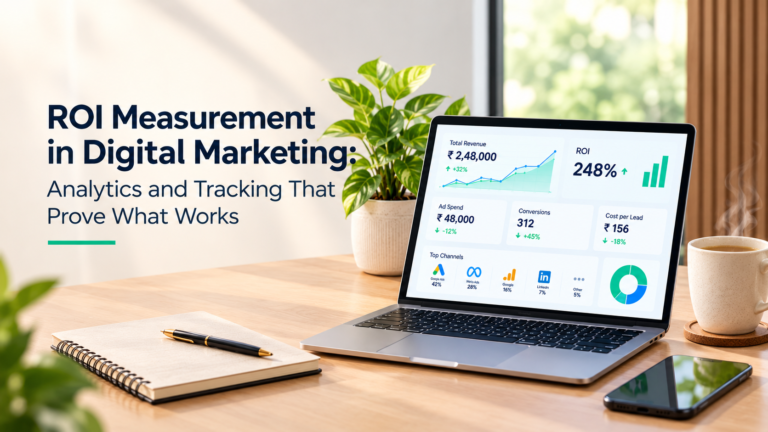
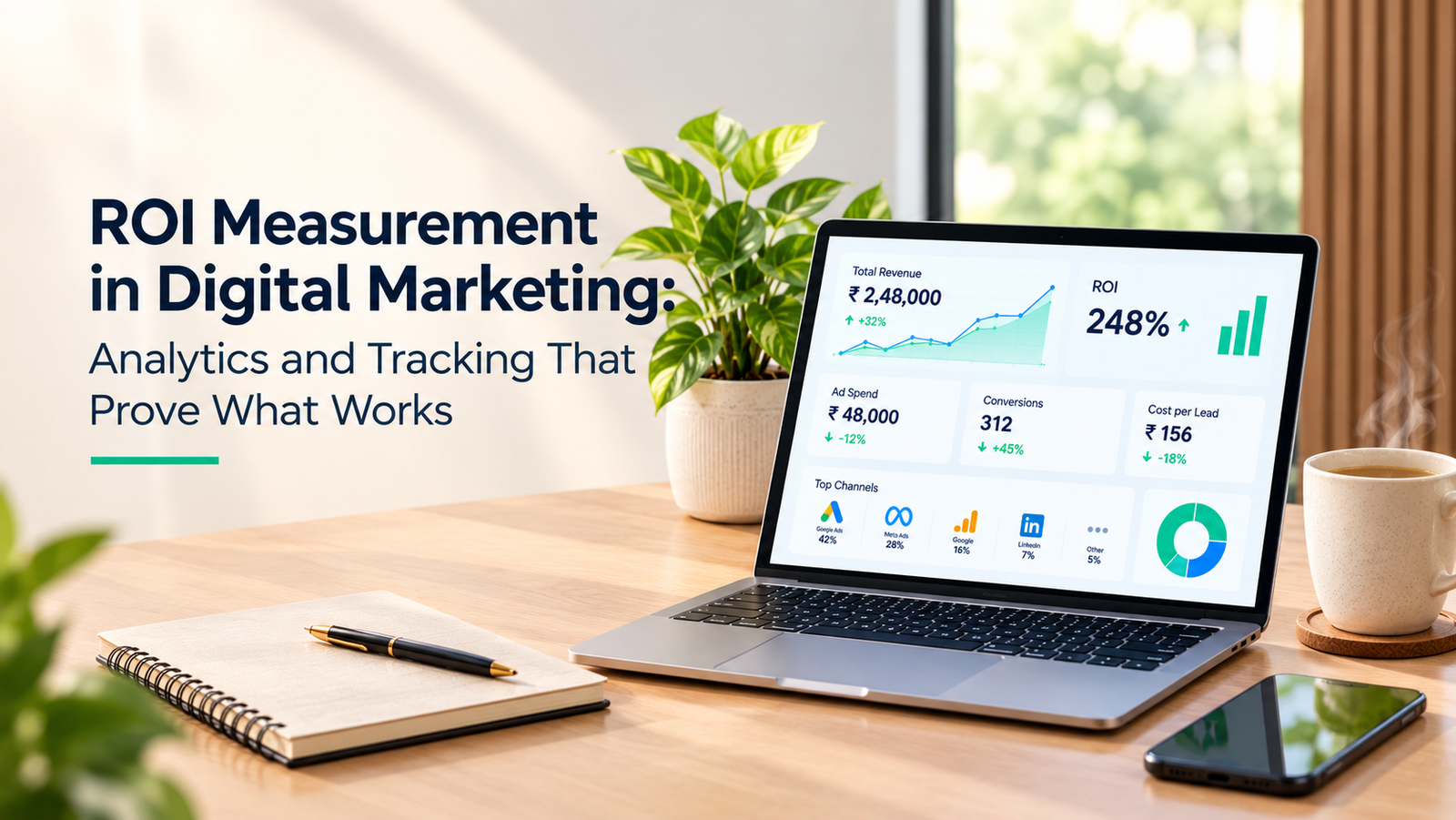
Most business owners can tell you how much they spent on marketing last month. Far fewer can tell you what that money brought back. That gap is exactly where ROI measurement in digital marketing starts. When analytics and tracking are set up properly, marketing stops being an expense you hope is working and becomes a system you can explain, defend and improve.This guide shows how analytics, tracking and ROI fit together, what to set up first, which numbers deserve your attention, and how to build a reporting routine you will actually follow.
Analytics, Tracking and ROI: Three Different Jobs
People often use these words as if they mean the same thing. They do not. Tracking is a collection. It is the code, pixels and tags that record what visitors do on your website or in your ads. Analytics is interpretation. It turns raw activity into reports, such as which channels bring visitors and which pages lose them. ROI measurement is the money layer. It compares what you earned against what you spent, so you know where the next rupee or dirham should go. If tracking is broken, analytics misleads you. If analytics is unclear, ROI becomes guesswork. So the order matters: fix collection first, then reporting, then the financial math. In our experience working with businesses across India and the UAE, the most common problem is not bad marketing. It is marketing that nobody can measure.
Start With What Counts as a Win
Before you open any dashboard, answer one question: which action actually makes your business money? For a clinic, it may be an appointment request. For an online store, it is a completed purchase. For a service company, it could be a quote form or a phone call.In Google Analytics 4, these actions are called key events. Google's help page on key events in GA4 explains that any event you collect can be marked as important to your business, so it appears across your reports and can be shared with Google Ads as a conversion. Without this step, GA4 simply counts traffic, and traffic alone has never paid anyone's salary.
Main Goals and Supporting Signals
Split your goals into two groups. Main goals bring revenue directly: purchases, bookings and qualified leads. Supporting signals are smaller steps, like a brochure download, a video view or a click on the WhatsApp button. Track both, but judge performance on main goals first. Supporting signals explain the journey, not the result.
Set Up Tracking You Can Trust
Good measurement rests on careful, slightly boring setup. Here is where most businesses should begin.
Configure GA4 Properly
Install GA4, mark your key events, filter out internal traffic and link it with Google Ads and Search Console. If the platform is new to you, our guide on what Google Analytics is and how it works covers the fundamentals in plain language.
Tag Every Campaign With UTM Parameters
UTM tags tell analytics exactly which email, ad or social post sent a visitor. Pick one naming pattern for your whole team, keep it lowercase and write it down. Inconsistent tags like "Facebook", "facebook" and "fb" split one channel into three rows, and your reports become hard to trust.
Install Ad Platform Conversion Tags
Meta and Google Ads need their own conversion tracking so their systems learn from real results. The same setup also powers audience building, which is the base of our retargeting and remarketing ads guide. Test every tag with a real form submission before launch, not after.
Do Not Forget Calls and Chats
For many businesses, the sale happens on a call or WhatsApp, not on a checkout page. Use call tracking numbers, click-to-chat events and a simple lead log that records the source of each enquiry. Ask new customers how they found you as well. It is low tech, and it catches what software misses.
Connect Every Channel to Revenue
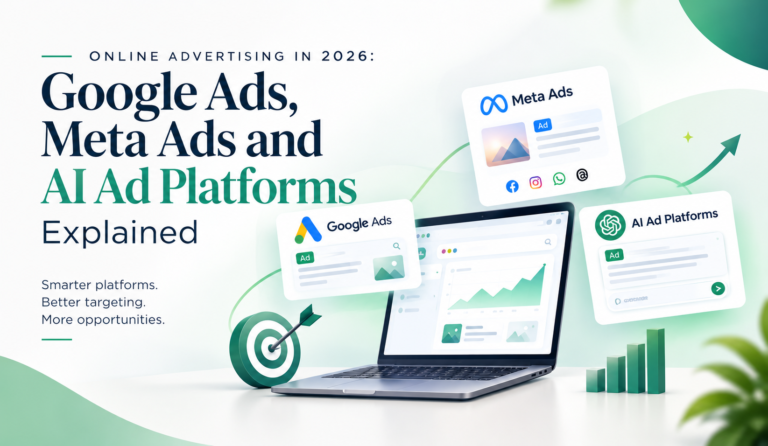
Once tracking works, compare channels on outcomes, not clicks. A channel with cheap clicks and no enquiries is expensive. A channel with pricey clicks and steady sales may be your best performer.Paid platforms also report results differently, so their numbers rarely match GA4 exactly. That is normal. Use GA4 as the neutral reference and platform data to optimise inside each campaign. Our breakdown of online advertising across Google, Meta and AI ad platforms explains why those differences happen. For online stores, revenue by channel, product and repeat purchase tells the real story, which we cover in ecommerce marketing in 2026.
The ROI Numbers Worth Watching
You do not need twenty metrics. These six are enough for most businesses: ROI: (revenue from marketing minus marketing cost) ÷ marketing cost × 100 ROAS: revenue ÷ ad spend Cost per lead: marketing spend ÷ number of leads Customer acquisition cost: total sales and marketing spend ÷ new customers Conversion rate: conversions ÷ sessions Customer lifetime value: average order value × purchase frequency × customer lifespan
An Illustrative Example
This is a hypothetical scenario to show the math, not a client result. Imagine a home services business spends ₹50,000 a month on Google Ads and gets 40 enquiries. Cost per lead is ₹1,250. If 10 enquiries become customers at an average job value of ₹20,000, revenue is ₹2,00,000 and ROAS is 4.That looks great. But if the business keeps only 20% as profit, that ₹2,00,000 leaves ₹40,000 in margin, which is less than the ₹50,000 spent. ROI calculated on profit tells you the campaign loses money, while ROAS alone hides it. This is why every business should know its break-even ROAS before judging any campaign.
Common Measurement Mistakes
Judging by traffic alone. Visits feel good, but enquiries and sales pay the bills. Ignoring data quality. Duplicate tags, spam traffic and unfiltered internal visits all inflate your numbers. Judging too early. SEO and content marketing need months to show their full return, so compare them over longer windows than paid ads. Trusting last-click only. Many customers see several touchpoints before they convert, so look at assisted conversions too. Building reports nobody reads. If a report does not lead to a decision, simplify it.
A Simple Reporting Routine
Weekly: check key events, ad spend and any sudden tracking drops. Monthly: compare channels by cost per lead and revenue. Review organic visibility in the Search Console Performance report, which shows clicks, impressions and the queries that bring people to your pages. Quarterly: revisit your goals, pause what is not paying back and move budget to what is.
Frequently Asked Questions
What is the difference between analytics and tracking?
Tracking collects the data through tags, pixels and events. Analytics is the reporting layer that helps you understand it. How do I calculate marketing ROI?
Subtract your marketing cost from the revenue it generated, divide by the cost, then multiply by 100. For a truer picture, use profit instead of revenue wherever you can. What is a good ROAS?
It depends on your margins and industry. A ROAS that looks healthy for a high-margin service can lose money for a low-margin store, so work out your break-even ROAS first. How long before I see ROI from SEO and content?
Usually several months. Paid ads can show results within days, so measure each channel against a realistic timeline.
Final Thoughts
Strong ROI measurement in digital marketing is not about collecting more data. It is about collecting the right data and acting on it. Define your wins, track them cleanly, connect them to revenue and review them on a fixed schedule. If you want a team to set this up and read the numbers with you, the digital marketing team at Medowa Global is happy to help.